
Volcanoes National Park Rwanda:Price, Hotel, Weather, & more
Volcanoes National Park Rwanda: Here’s Everything about Volcanoes National Park Rwanda — gorillas, permit prices, altitude, weather, accommodation, and whether it’s worth visiting. Plan your trek.
Volcanoes National Park (Parc National des Volcans) is Rwanda’s only mountain gorilla safari park — and for most travelers researching a Rwanda gorilla trek, it’s the single destination the entire trip is built around.
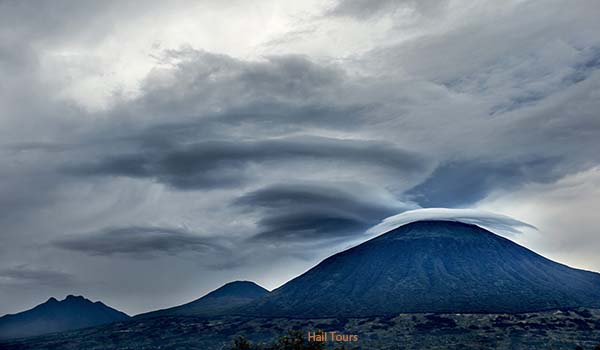
Set in the far northwest of Rwanda within the Virunga Conservation Area, the park’s ecosystem moves through bamboo forest, swamp, heath, and evergreen vegetation across the slopes of five dormant volcanoes.
This guide covers everything you need to know about Volcanoes National Park Rwanda — gorillas, permit prices, altitude, weather, accommodation, and honestly, whether it’s actually worth the cost and effort to visit.
Where Is Volcanoes National Park and How Do You Get There?
Volcanoes National Park sits in the extreme northwest of Rwanda, near the borders with Uganda and the Democratic Republic of Congo, as part of the wider Virunga Mountain range that shelters the region’s endangered mountain gorilla population.
On the Volcanoes National Park Rwanda map, the park is easiest reached by road from Kigali — roughly 2 to 3 hours’ drive, or about a 2-hour drive to the nearby town of Musanze, from which the park entrance is only around 10km further.
Most visitors hire a 4×4 safari vehicle for the trip; an alternative route runs from Kabale or Kisoro in Uganda through the Cyanika or Katuna border crossing, taking 3–5 hours depending on your driver’s pace. See our full guide on gorilla trekking in Rwanda for more on planning the logistics side of your trip.
Volcanoes National Park Rwanda: A Brief History
Parc National des Volcans is one of the oldest national parks in Africa, founded in 1925 and covering a compact 160 square kilometres. It takes its name from the chain of dormant Virunga volcanoes, five of which sit within the park itself — Muhabura, Gahinga, Bisoke, Sabyinyo, and Karisimbi, the tallest of all eight Virunga volcanoes at 4,507 metres. The park forms part of the larger Virunga Conservation Area, which also extends into Mgahinga Gorilla National Park in Uganda and Virunga National Park in the DRC — meaning the mountain gorilla population here isn’t confined to Rwanda alone, but moves across a genuinely trans-boundary conservation landscape.
Volcanoes National Park Rwanda Altitude and Terrain
Elevation is one of the defining features of a Volcanoes National Park trek, and it’s worth understanding before you book. The park’s lower boundary near the Kinigi park headquarters sits at roughly 2,400 metres above sea level, with gorilla trekking typically taking place across forested slopes between 2,500 and 3,000 metres.
The five volcanoes themselves climb far higher — Bisoke at 3,711 metres and Karisimbi, the highest point in the park, at 4,507 metres, ranking 11th highest on the entire African continent.
This altitude is exactly why layered clothing matters more here than on a typical savannah safari: mornings and evenings at Volcanoes National Park’s elevation run genuinely cold, even though Rwanda sits on the equator.
Are There Gorillas in Volcanoes National Park?
Yes — Volcanoes National Park is the only place in Rwanda where mountain gorillas (Gorilla beringei beringei) can be seen, and it’s one of only three countries on earth where this subspecies exists at all, alongside neighbouring Uganda and the DRC.
Thirteen gorilla families have been fully habituated and are officially open for gorilla trekking in Volcanoes National Park Rwanda, including Titus, Amahoro, Agashya, Susa A, Karisimbi/Susa B, Sabyinyo, Hirwa, Kwitonda, Ugenda, Umubano, and Bwenge, among others. Additional groups exist purely for ongoing research rather than tourism.
Volcanoes National Park Rwanda Wildlife Beyond the Gorillas
While mountain gorillas are the headline draw, Volcanoes National Park’s biodiversity extends well beyond them. Golden monkeys, spotted hyenas, elephants, bushbucks, buffaloes, and black-fronted duikers all inhabit the park, and birders will find up to 200 recorded species, heavily weighted toward Albertine Rift endemics — the handsome francolin, dusky crimson wing, Grauer’s rush warbler, Rwenzori double-collared sunbird, Rwenzori turaco, and Rwenzori batis among the specialities worth watching for.
Gorilla Trekking in Volcanoes National Park
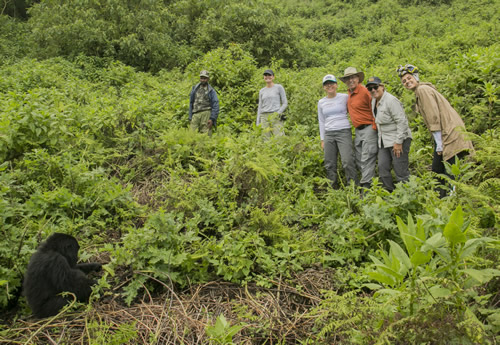
Gorilla trekking remains Volcanoes National Park’s most popular activity by a wide margin. Each of the 13 open gorilla families is limited to just 8 visitors per day, with treks beginning at 8:00am following a briefing at the park’s Kinigi headquarters.
A trek can run anywhere from 2 to 6 hours depending on where your assigned family is located that day and your own hiking pace, but every trek guarantees a full hour face-to-face with the gorillas once you locate them — an experience most visitors describe as the single reason the whole trip was worth planning.
Volcanoes National Park Rwanda Gorilla Permit Price
A Volcanoes National Park gorilla permit costs USD 1,500 per person for international visitors, issued directly by the Rwanda Development Board (RDB), with discounted rates sometimes available for East African citizens and residents.
Given consistently high demand, we strongly recommend booking your permit 2 to 4 months ahead of your intended trekking date — permits for popular periods do sell out. Reach out to our reservations team at Hail Tours Uganda to secure yours early and avoid disappointment.
Golden Monkey Tracking in Volcanoes National Park
Golden monkey tracking is the park’s second most sought-after primate experience, offering a genuinely different encounter from gorilla trekking. Like gorilla treks, golden monkey tracking begins with a briefing at the Kinigi park offices, with two habituated troops available for visitors to explore.
A golden monkey permit costs USD 100 per person — a meaningfully more affordable primate experience that pairs well with a gorilla trek on the same trip.
Other Top Attractions and Activities in Volcanoes National Park
Dian Fossey’s tomb and the Karisoke Research Center — Dian Fossey spent 18 years in the Virunga volcanoes researching and protecting mountain gorillas before her murder in 1985; she’s buried near Digit, the gorilla she was closest to.
The Dian Fossey hiking trail, a 2–3 hour hike through the same terrain she worked in, is a moving and genuinely worthwhile addition to a gorilla trekking trip.
Volcano hiking — Mount Karisimbi (4,507m) requires a demanding two-day climb; Mount Bisoke (3,711m), known for its scenic crater lake at the summit, takes around 6 hours; Mount Gahinga (3,474m) also runs roughly 6 hours. All five Virunga volcanoes within the park are open to sufficiently prepared hikers.
Musanze Caves — a roughly 2km cave system near Musanze town, easily combined with a visit either before or after your gorilla trek.
Cultural visits — Iby’Iwacu Cultural Village (also known as the Gorilla Guardian’s Village) offers genuine insight into Rwandan traditions, music, and dance, and is a natural complement to the park’s wildlife focus.
Lake Burera and Lake Ruhondo — the “Twin Lakes,” best explored by boat, with island stops and birdlife including African spoonbills and weaver birds.
Volcanoes National Park Rwanda Weather and Best Time to Visit
Volcanoes National Park is open year-round, but weather genuinely shapes the trekking experience. Rwanda’s two dry seasons — the short dry season from December to February and the longer one from June to September — offer the most favourable conditions for both gorilla trekking and golden monkey tracking, with firmer trails and lower rainfall.
The wetter seasons run March to May (long rains) and October to November (short rains); trekking remains possible throughout, but expect muddier, more physically demanding trails.
Given the park’s altitude, temperatures stay noticeably cooler than lowland Rwanda regardless of season — mornings can be genuinely cold, which is why proper layering matters as much as rain protection.
Is There Malaria in Volcanoes National Park, Rwanda?
Malaria risk at Volcanoes National Park itself is considerably lower than in Rwanda’s lower-altitude regions, since the park’s elevation — generally above 2,400 metres — creates cooler conditions that meaningfully suppress mosquito activity.
That said, most Rwanda itineraries also include lower-elevation destinations such as Kigali, Akagera National Park, or parts of Nyungwe Forest, where malaria risk is more comparable to the rest of East Africa.
For that reason, health authorities generally still recommend antimalarial prophylaxis for a full Rwanda trip, alongside standard precautions — insect repellent, covering up at dawn and dusk, and sleeping under treated netting where provided. Always consult a travel health professional or clinic before departure to confirm the right approach for your specific itinerary and medical history.
Volcanoes National Park Rwanda Accommodation
All categories of Volcanoes National Park Rwanda accommodation are available, from budget guesthouses to some of the most talked-about luxury lodges in East African travel.
Options span Sabyinyo Silverback Lodge, Bisate Lodge, Le Bambou Gorilla Lodge, Virunga Lodge, Gorilla Volcanoes Lodge, Kinigi Guesthouse, Da Vinci Gorilla Lodge, Garden Palace Hotel, One&Only Gorilla’s Nest, Kwitonda Lodge, and Muhabura Hotel, among others.
Whether you’re after a Volcanoes National Park Rwanda hotel for a simple, comfortable base or a genuinely high-end lodge experience to bookend your gorilla trek, Hail Tours Uganda can match accommodation to your budget and travel style as part of your full itinerary.
What to Pack for Gorilla Trekking or Golden Monkey Tracking
Essential items include your gorilla or golden monkey permit, a camera with flash disabled, a rain jacket, insect repellent, waterproof hiking boots, sunscreen, gardening gloves for gripping vegetation, and long-sleeved shirts. Don’t forget a first aid kit, long trousers, a daypack, snacks, toiletries, and bottled water — Volcanoes National Park’s terrain and altitude reward genuine preparation.
Is It Worth Visiting Volcanoes National Park?
For most travelers, yes — genuinely and without much hesitation. A permit price of USD 1,500 is a significant sum, and it’s fair to weigh that cost honestly before booking. What you’re paying for is a guaranteed hour in the direct presence of a habituated mountain gorilla family, one of roughly 1,000 individuals left in the wild globally, in an experience that directly funds the conservation work keeping the species from extinction.
Combined with golden monkey tracking, volcano hiking, the Dian Fossey trail, and cultural visits all available within the same compact park, Volcanoes National Park delivers a density of genuinely rare experiences that few other destinations on earth can match.
The honest caveat: if your budget genuinely can’t stretch to the permit cost, Uganda’s Bwindi Impenetrable National Park offers a comparable gorilla trekking experience at a lower permit price — see our comparison guide on gorilla trekking in Rwanda vs Uganda to weigh both options properly before deciding.
FAQs About Volcanoes National Park Rwanda
Where is Volcanoes National Park located? In the northwest of Rwanda, near the borders with Uganda and the DRC, as part of the Virunga Mountain range.
How do I get to Volcanoes National Park? About a 2-hour drive from Kigali by private car or tour operator, with Musanze the nearest town, roughly 10km from the park entrance.
What activities can I do in Volcanoes National Park? Gorilla trekking, golden monkey tracking, volcano hiking (Karisimbi, Bisoke, and others), cultural visits to Iby’Iwacu Village, and birdwatching across the park’s 200 recorded species.
How much does gorilla trekking cost? USD 1,500 per person for international visitors, with possible discounts for East African citizens and residents.
What is the best time to visit Volcanoes National Park? The dry seasons — June to September and December to February — offer the most favourable trekking conditions, though trekking is possible year-round.
Do I need a permit for gorilla trekking? Yes, issued by the Rwanda Development Board, and best booked 2–4 months in advance given consistently high demand.
How difficult is gorilla trekking? It varies considerably by group and terrain — anywhere from 30 minutes to 6 hours of hiking — so reasonable physical fitness genuinely helps.
What should I wear for trekking? Long sleeves, long trousers, sturdy waterproof hiking boots, a hat, gloves, and a rain jacket, plus sunscreen and insect repellent.
How many people can join a single gorilla trek? Each gorilla family is limited to 8 visitors per day, to minimise human impact and protect the animals.
Are there accommodations near Volcanoes National Park? Yes, ranging from budget guesthouses to luxury lodges including Bisate Lodge and Sabyinyo Silverback Lodge — see our accommodation section above for the full range.
Can I visit other national parks after Volcanoes? Yes — Nyungwe Forest National Park for chimpanzee trekking and Akagera National Park for classic savannah wildlife are both realistic additions to a Rwanda itinerary. See our Rwanda national parks guide for the full picture.
Is it safe to visit Volcanoes National Park? Yes — Rwanda is consistently ranked among the safest countries in Africa for tourists, and the park itself is well managed with a strong conservation and eco-tourism focus.
What happens if I feel unwell during trekking? Inform your guide immediately — rangers are trained to assist, and disclosing any relevant medical conditions before the trek helps them prepare properly.
Can I take photos during gorilla trekking? Yes, but flash photography is strictly prohibited, since it can disturb and distress the gorillas.
Plan Your Volcanoes National Park Rwanda Trip With Us
Volcanoes National Park rewards travelers who plan properly — securing permits early, choosing the right season, and pairing gorilla trekking with the park’s other genuinely worthwhile experiences rather than rushing through in a single day.
Hail Tours Uganda handles the entire process for you: permit booking through the Rwanda Development Board, accommodation matched to your budget, and a full itinerary built around your gorilla trekking date.
Explore our 2 Days Rwanda Gorilla Trekking Safari for the shortest practical option, our 3 Day Gorilla & Golden Monkey Trekking Rwanda itinerary to combine both primate experiences, or our 8 Days Rwanda Gorilla Trekking safari for a fuller Rwanda circuit.
Travelers weighing a cross-border trip can also see our 8 Days Uganda Rwanda Safari and 7 Days Uganda Rwanda Wildlife Safari itineraries, or our guide on how to book a gorilla trek and safari before you commit to dates.
Get in touch with our team today to check gorilla permit availability and start planning your Volcanoes National Park Rwanda safari.
Email: info@hailtoursuganda.com
Related Pages
- Gorilla Trekking Rwanda
- Best Rwanda Safari Parks
- Rwanda Safari Activities
- Best Time to Visit Rwanda
- Gorilla Trekking Rwanda vs Uganda
- 2 Days Rwanda Gorilla Trekking Safari
- 3 Days Rwanda Wildlife Safari
- 3 Days Nyungwe National Park Safari
- 8 Days Rwanda Gorilla Trekking
- 3 Day Gorilla & Golden Monkey Trekking Rwanda
- 5 Days Rwanda Congo Gorilla Safari
- 4 Day Kigali to Bwindi Gorilla Trekking Tour
- 8 Days Uganda Rwanda Safari
- 7 Days Uganda Rwanda Wildlife Safari
- Bwindi Impenetrable National Park
- Uganda Gorilla Trekking
- How to Book a Gorilla Trek and Safari
- About Hail Tours Uganda