Intriguing Facts About the African Grey Crowned Crane
Grey crowned crane: The Grey Crowned Crane, scientifically called Balearica regulorum, is an iconic bird renowned for its majestic beauty, graceful movements, and symbolic significance in many African cultures. Native to Africa, this bird is celebrated as a symbol of elegance and natural wonder. Let’s dive into some fascinating aspects of this extraordinary bird.
Why is the grey crowned crane called “crowned”?
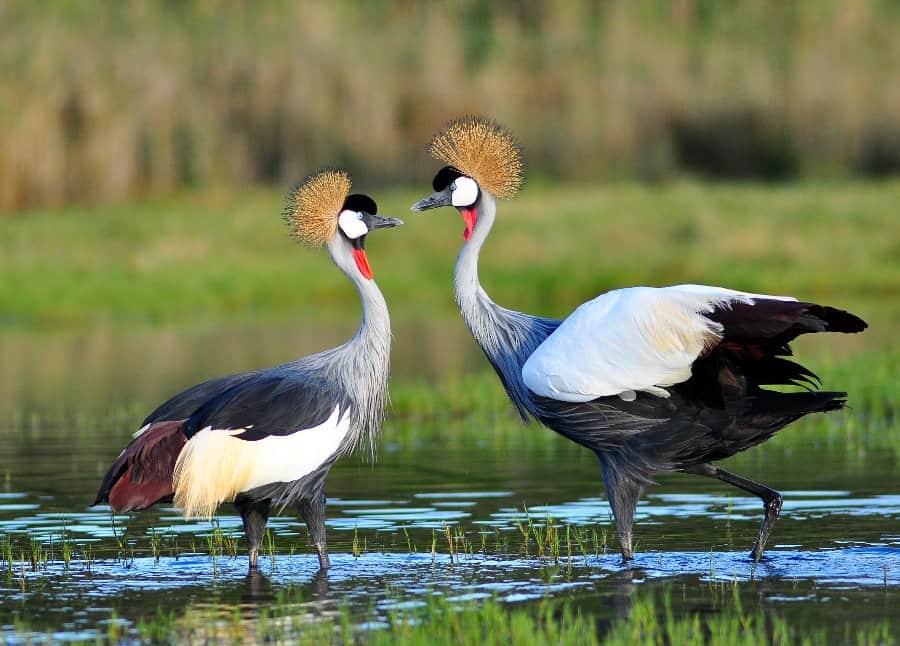
The grey crowned crane is called “crowned” because of the striking golden crown of stiff, spiky feathers on the top of its head. This unique feature resembles a royal crown, giving the bird its regal and elegant appearance.
The golden crest is made of coarse, bristle-like feathers that fan out in a circular shape, making the bird stand out among other crane species.
This crown of feathers is not just beautiful but also an important part of its courtship displays and social interactions, symbolizing its grace and earning it the name “grey crowned crane.”
Taxonomy and Classification
The grey crowned crane belongs to the family Gruidae, which includes 15 species of cranes worldwide. It is classified under the genus Balearica, which comprises only two species: the grey crowned crane (Balearica regulorum) and the black crowned crane (Balearica pavonina).
These two species are unique among cranes for their arboreal habits, enabled by a long, prehensile hind toe—a feature absent in other crane species, which are primarily terrestrial.
The grey crowned crane is divided into two subspecies:
- Balearica regulorum gibbericeps (East African crowned crane): Found from the eastern Democratic Republic of Congo, Uganda, and Kenya south to northern Zimbabwe and Mozambique. This subspecies is more widespread and is distinguished by a larger area of bare red facial skin above its white cheek patches.
- Balearica regulorum regulorum (South African crowned crane): Distributed from southern Angola and northern Namibia east through Botswana to Zimbabwe and south to South Africa. This subspecies has a smaller red facial patch and is less numerous due to habitat constraints.
The grey crowned crane is considered one of the most primitive living crane species, with fossil evidence suggesting that crowned cranes date back to the Eocene period (34–55 million years ago).
Ancient records indicate that at least 11 crowned crane species once existed in Europe and North America, underscoring their deep evolutionary history.
Physical Appearance and Features of a Grey Crowned Crane
The grey crowned crane is a visually stunning bird, standing approximately 1 meter (3 feet 3 inches) tall, with a wingspan of about 2 meters (6 feet 7 inches) and a weight of 3–4 kilograms (6.6–8.8 pounds). Its distinctive features make it one of the most recognizable cranes.
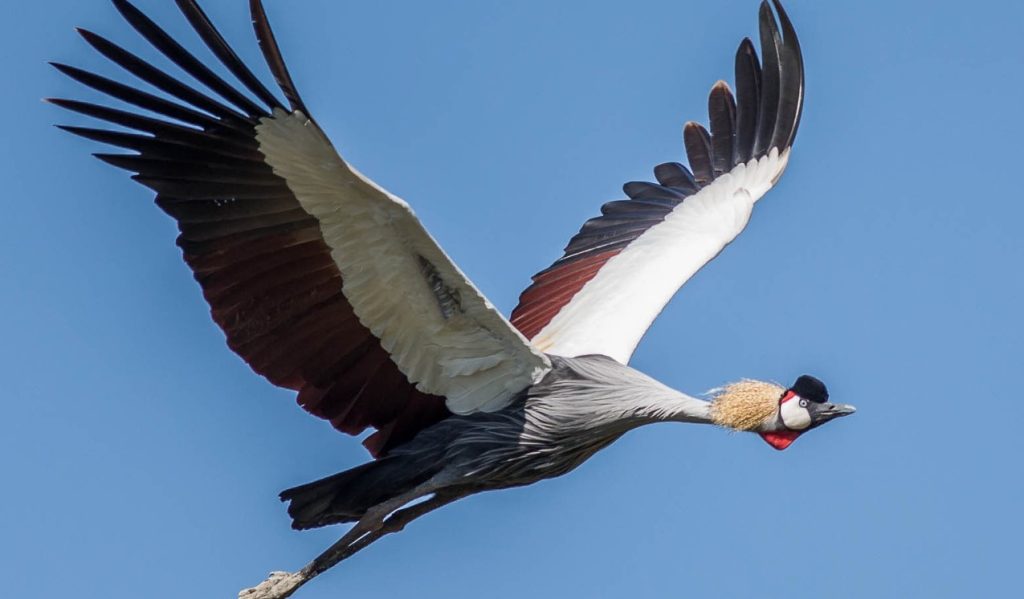
- Plumage: The body is predominantly grey, with a pale grey neck contrasting with darker grey feathers on the body. The wings are primarily white, featuring a mix of brown, gold, and black feathers, with a prominent black patch at the top. The tail is black, and the upper coverts are pale, straw-like yellow, adding to its vibrant appearance.
- Head and Crown: The hallmark feature is the crown of stiff, golden feathers tipped with black, forming a radiant, halo-like crest. The head is black with large, white cheek patches and a small red patch above. The East African subspecies (B. r. gibbericeps) has a more pronounced red facial patch compared to the South African subspecies (B. r. regulorum).
- Facial Features: A bright red inflatable gular sac (throat pouch) hangs below the chin, used for vocalizations and displays. The eyes are pale grey to blue, and the bill is short, grey, and sturdy, adapted for pecking and probing.
- Legs and Feet: The crane has long, black legs suited for wading through tall grasses and wetlands. Its slender feet include a long hind toe, enabling it to perch in trees—a unique trait among cranes.
- Juveniles: Young cranes are greyer, with a brown crown and nape, brown eyes, and a feathered buff face. The gular sac appears pink at around four months and turns red as they mature. Full adult plumage is typically acquired after 12 months.
Sexual dimorphism is minimal, with males slightly larger than females but otherwise nearly identical in appearance.
Behavior and Social Structure
Grey crowned cranes are highly social and gregarious, forming flocks of up to 200 birds outside the breeding season. Their behaviors, particularly their courtship dances, are among the most captivating in the animal kingdom.
- Social Behavior:
- During the non-breeding season, cranes congregate in large flocks, roosting together in trees or shallow water. These flocks provide protection from predators and facilitate cooperative foraging.
- They are diurnal, active during the day, and rest at night in elevated perches or wetlands.
- Communication includes a range of vocalizations: a trumpeting “may hem” flight call, low-pitched “huum huum” honks during breeding displays, and a soft purring contact call. Chicks produce a shrill “peeep” to communicate with parents.
- Courtship Displays:
- The grey crowned crane is famous for its elaborate courtship dances, which involve synchronized bowing, jumping, wing-fluttering, and running. Both sexes participate, and dances serve to strengthen pair bonds, attract mates, relieve tension, or deflect aggression.
- The booming call, produced by inflating the red gular sac with the head lowered, is a key display element. The unison call, a duet of long, low male calls and short, high-pitched female calls, announces territory and reinforces bonds.
- Dancing is not exclusive to breeding season; juveniles and non-breeding adults may dance to develop social and physical skills.
- Territoriality:
- During the breeding season, mated pairs become highly territorial, defending nesting sites with loud calls and displays. Foraging areas remain communal, allowing cranes to feed alongside other species or conspecifics.
Habitat and Distribution
Where do grey crowned cranes live?
The grey crowned crane inhabits a wide range of ecosystems across East and Southern Africa, from Kenya and Uganda to South Africa and Zimbabwe. Its distribution includes countries such as Angola, Botswana, Burundi, the Democratic Republic of Congo, Kenya, Malawi, Mozambique, Namibia, Rwanda, Tanzania, Uganda, Zambia, Zimbabwe, Lesotho, and Swaziland. The largest populations are found in Kenya, Uganda, Tanzania, and Zambia, with significant declines in some regions due to habitat loss.
Preferred habitats include:
- Wetlands and Marshes: These are critical for nesting, providing dense vegetation for cover. Cranes nest along the edges of permanent or temporary wetlands, such as marshes, floodplains, and farm dams.
- Grasslands and Savannahs: Medium-height open grasslands near wetlands are ideal for foraging, offering grass seeds and insects.
- Cultivated Areas: In East Africa, cranes are commonly found in pastures, croplands, and irrigated fields, where they feed on crops like millet, soybeans, and maize. In South Africa, they frequent marshes, grasslands, and agricultural lands.
- Tree Roosting Sites: Their ability to roost in trees requires habitats with tall trees or shrubs, distinguishing them from other cranes that roost on the ground or in water.
Grey crowned cranes are non-migratory but undertake local and seasonal movements in response to food availability, water levels, and nesting opportunities. In arid regions like Namibia, they may travel more extensively during dry periods, while those in tropical areas remain more sedentary.
Grey crowned crane habitat: wetlands, savannas, and grasslands
How Seasonal Changes Affect Grey Crowned Cranes
Seasonal changes impact grey crowned cranes’ behavior and movements. During the rainy season, wetlands and marshes expand, providing abundant food and breeding sites. The cranes take advantage of this by nesting and raising their young.
In the dry season, shrinking water sources force them to move to wetter areas, sometimes migrating locally in search of food and water. Seasonal vegetation changes also influence their diet, with more insects and seeds available during wet months. These adaptations help them survive fluctuating environmental conditions.
Grey Crowned Crane Diet and Feeding Habits
Grey crowned cranes have a varied diet that includes insects, small reptiles, seeds, grasses, and aquatic plants. They forage in wetlands, grasslands, and agricultural fields, using their sharp beaks to pick food from the ground or shallow water.
Grey crowned cranes are omnivorous, with a versatile diet that reflects their adaptability to diverse environments. They feed on both plant and animal matter, foraging primarily during the day.
- Plant Matter:
- Grass seeds, particularly from sedges (Cyperus spp.).
- Fresh grass tips and grain.
- Agricultural crops such as millet, soybeans, maize, groundnuts, and potatoes.
- Animal Matter:
- Insects (grasshoppers, crickets, locusts).
- Worms, frogs, lizards, snakes, small fish, and eggs of aquatic animals.
- Foraging Techniques:
- Cranes use a foot-stamping technique while walking through grasslands to flush out insects, which they quickly seize.
- They often follow grazing herbivores like antelopes, gazelles, buffalo, or cattle, feeding on insects disturbed by these animals.
- Their sturdy bill is used to probe for roots, seeds, or invertebrates in soil or shallow water.
Grey crowned cranes are not territorial over foraging areas, allowing them to feed in flocks of 30–150 individuals during the non-breeding season. They are diurnal, spending most of their day foraging and roosting in trees or water at night for safety.
Grey Crowned Reproduction and Life Cycle
Grey crowned cranes are monogamous, typically forming lifelong pair bonds, and their reproductive behaviors are closely tied to environmental conditions, particularly rainfall.
- Breeding Season:
- In East Africa, breeding occurs year-round, with a peak during drier periods (December–February). In South Africa, it coincides with the rainy season (November–December).
- Rainfall influences nest site availability, as wetlands provide cover from predators like jackals and birds of prey.
- Nesting:
- Pairs select nest sites within their territory, often along wetland edges or in dense aquatic vegetation. Nests are circular platforms made of uprooted grasses and sedges, rarely built in trees or using abandoned nests of other species.
- Both parents collaborate in nest construction and perform unison calls to mark the site.
- Eggs and Incubation:
- Females lay 1–4 eggs (typically 2–5), which are glossy, dirty-white, or light blue—the largest clutch size among cranes.
- Both parents incubate the eggs for 28–31 days, taking shifts to allow foraging. If predators approach, parents may feign injury to lure them away.
- Chicks:
- Chicks are precocial, able to run and swim within hours of hatching. They are pale buff with an ivory head and rely on parents for protection and feeding.
- Fledging occurs in 56–100 days, with adult plumage acquired by 12 months. Sexual maturity is reached at 2–3 years, after which young cranes leave their parents to join flocks or form pairs.
Grey crowned crane lifespan
The grey crowned crane has an impressive lifespan, especially in captivity.
In the wild, they typically live 20 to 25 years, depending on habitat quality, predation, and food availability.
In captivity, where they are protected from predators and receive regular care, they can live up to 35 to 40 years.
Their longevity is helped by their strong pair bonds, territorial nature, and adaptability to wetland and grassland environments. However, threats like habitat loss and human disturbance in the wild can sometimes shorten their life expectancy.
These graceful birds’ long lives make them a lasting symbol of elegance and resilience in African ecosystems.
Cultural Significance
Conservation Status and Threats
Unique Behaviors and Traits
The Grey Crowned Crane is a highly social bird, often seen in pairs or small family groups. During the non-breeding season, it may form larger flocks of up to 200 individuals. These gatherings are a spectacular sight, showcasing the birds’ synchronized movements and harmonious calls.
One intriguing behavior is the bird’s ability to roost in trees, a trait unique among cranes. Its long toes allow it to perch on branches, providing safety from ground predators during the night.

The Grey Crowned Crane is also known for its distinctive call, a loud, honking sound that can carry over long distances. This call is often used to communicate with mates or signal the presence of intruders.
Photography & Tourism
Interesting Facts
- The Grey Crowned Crane is sometimes called the “African Crane” due to its prominence on the continent.
- It has a lifespan of up to 25 years in the wild and even longer in captivity.
- The bird’s crown of feathers is not just for show; it plays a role in attracting mates and intimidating rivals.
- Unlike many birds, the Grey Crowned Crane does not migrate but may undertake local movements in search of food and water.
- Its elegant dance has inspired traditional rituals and modern performances, cementing its status as a cultural icon.
Why Protect the Grey Crowned Crane?
The Grey Crowned Crane is more than just a beautiful bird; it is a vital part of Africa’s ecosystem. As a seed disperser, it plays a crucial role in maintaining the health of grasslands and wetlands. Its presence also attracts eco-tourism, contributing to local economies and fostering conservation awareness.
Protecting the Grey Crowned Crane requires a collective effort. By preserving its habitat, reducing human-wildlife conflict, and supporting conservation initiatives, we can ensure that this magnificent bird continues to grace Africa’s landscapes for generations to come.
The Grey Crowned Crane is a symbol of Africa’s rich biodiversity and cultural heritage. Its striking appearance, unique behaviors, and ecological importance make it a true marvel of nature. By learning about and advocating for the protection of this endangered species, we can play a part in preserving one of the world’s most captivating birds.