
7 Days Uganda Birding Safari — The Ultimate Uganda Birding Tour 2026
This 7 Days Uganda Birding Safari takes you through four of the country’s most spectacular birding ecosystems — Mabamba Swamp, Bwindi Impenetrable National Park, Queen Elizabeth National Park, and Kibale National Park — delivering a birding experience that encompasses wetland specialists, Albertine Rift endemics, savannah raptors, forest secretives, and migratory visitors across one carefully sequenced week.
Whether you are an obsessive lister chasing Uganda’s endemic species or a first-time nature traveller wanting to experience the Pearl of Africa’s extraordinary wildlife, this is the birding itinerary that delivers the full spectrum.
Why Uganda Is the Best Birding Destination in Africa
Before diving into the day-by-day itinerary, it is worth understanding what makes Uganda so exceptional for birdwatching — because the numbers alone do not tell the whole story.
Uganda sits at the intersection of four major African biomes: the East African savannah, the Congo Basin rainforest, the Albertine Rift montane zone, and the Great Rift Valley lake systems.
This convergence of habitats in a single country creates what ornithologists call a “biogeographic crossroads” — a zone where species from multiple distinct faunal assemblages coexist and interact.
The result is that a 7-day Uganda birding tour can realistically encounter forest species that are otherwise only findable in the depths of the Congo Basin, savannah birds typical of the East African plains, mountain species restricted to the high Rwenzori and Virunga ranges, and waterbirds from the entire Lake Victoria basin — all without crossing an international border.
The 23 Albertine Rift endemic birds found in Bwindi Impenetrable National Park alone make Uganda a must-visit destination for any serious African birder.
Species like the African Green Broadbill, Grauer’s Rush Warbler, and Rwenzori Turaco cannot be reliably seen anywhere outside the Albertine Rift — and Uganda provides access to multiple Rift endemic sites in a single trip.
For an overview of Uganda’s broader wildlife context, our Uganda safaris page gives a complete picture of the destinations and experiences available.

7 Days Uganda Birding Safari — Highlights at a Glance
- Paddle by canoe through Mabamba Swamp for one of Africa’s most coveted birdwatching experiences: the Shoebill Stork in its natural papyrus habitat
- Spend a full day birding the ancient rainforest trails of Bwindi Impenetrable National Park, targeting 23 Albertine Rift endemic species including the African Green Broadbill
- Cruise the Kazinga Channel in Queen Elizabeth National Park — one of Africa’s great boat safaris for waterbirds, with over 600 species recorded in the park
- Bird the Ishasha Sector for savannah raptors, ground-dwelling species, and the park’s famous tree-climbing lions alongside extraordinary open-country birding
- Explore Bigodi Wetland Sanctuary at the edge of Kibale National Park for Great Blue Turaco, Black Bee-eater, and African Pygmy Kingfisher
- Search the deep forests of Kibale National Parkfor the elusive Green-breasted Pitta — one of Uganda’s most sought-after ticks for visiting birders worldwide
Brief 7 Days Uganda Birding Safari Itinerary Overview
Day 1: Arrival in Entebbe — Birding at Mabamba Swamp for the Shoebill Stork
Your Uganda birding adventure begins the moment you land at Entebbe International Airport, where your Hail Tours Uganda professional birding guide meets you for a warm welcome briefing and equipment check.
There is no wasted time: Mabamba Swamp, located on the northern shore of Lake Victoria just 45 minutes from Entebbe Airport, is one of the most important wetland birding sites in East Africa, and your first afternoon there sets the tone for everything that follows.
Mabamba is the single most reliable site in Uganda — and one of the most reliable in Africa — for seeing the Shoebill Stork (Balaeniceps rex), a prehistoric-looking waterbird that has become the defining avian symbol of Uganda birdwatching.
Birding in Mabamba is conducted entirely by traditional wooden canoe, poling silently through dense papyrus channels while your guide locates Shoebills hunting in the shallows.
The combination of the canoe approach, the papyrus-fringed waterways, and the extraordinary bird itself makes this one of the most memorable birdwatching experiences in Africa — for many visitors, it is the highlight of the entire trip.
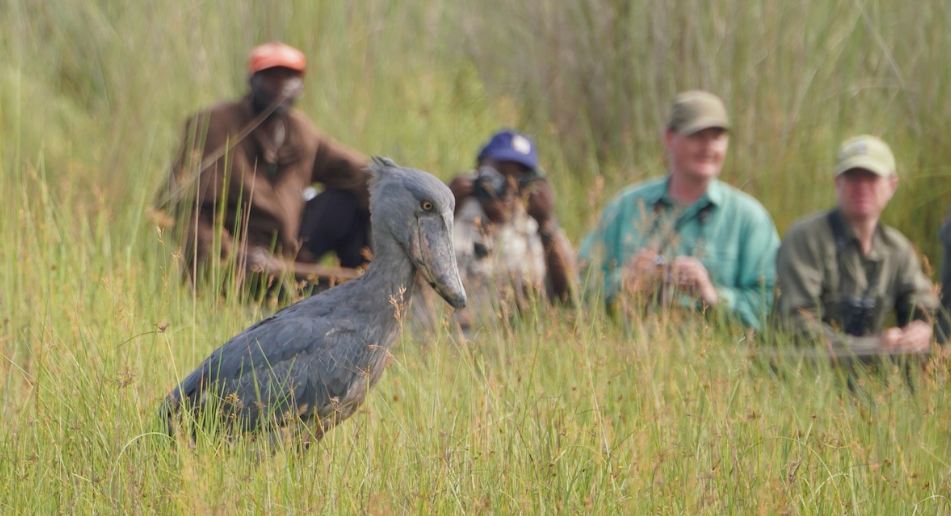
Key bird species to look for at Mabamba Swamp: – Shoebill Stork — Uganda’s most iconic and sought-after bird – African Jacana, stepping delicately across floating vegetation – Malachite Kingfisher in stunning iridescent plumage – Papyrus Gonolek, a papyrus specialist of brilliant red and black – Blue Swallow, a rare and vulnerable Afromontane species – White-winged Warbler and other papyrus endemics – Lesser Jacana, African Fish Eagle, Purple Heron
After a memorable afternoon on the water, transfer to your Entebbe accommodation for dinner and an overnight stay, reviewing your first day’s remarkable bird list.
Accommodation: Papyrus Guesthouse / Lake Victoria Serena Hotel Meals: Breakfast, Lunch, Dinner
Day 2: Transfer to Bwindi Impenetrable National Park — En Route Forest Birding
After an early breakfast, your driver-guide begins the scenic drive southwest to Bwindi Impenetrable National Park — a journey of approximately six hours that passes through the tea estates and rolling hills of southwestern Uganda and offers excellent en-route birding at two carefully chosen forest stops.
Mpanga Forest Reserve, a medium-altitude forest reserve near Fort Portal, delivers outstanding forest birding for species including the African Grey Parrot, African Broadbill, Yellow-throated Nicator, and various forest weavers and sunbirds.
Mpanga is a productive introductory forest for birders experiencing central African rainforest birding for the first time — the canopy structure is accessible and the species diversity is genuinely impressive for a brief stop.
Echuya Forest Reserve near Kabale is a montane forest at approximately 2,200 metres elevation that provides a preview of the Albertine Rift endemic avifauna you will encounter more fully in Bwindi.
Look specifically for Montane Oriole, Mountain Illadopsis, Ruwenzori Batis, and Kivu Ground Thrush — species whose ranges are largely restricted to the montane forests of the Albertine Rift. The forest is compact and walkable in an hour, but the returns are exceptional.
Arriving at Bwindi in the late afternoon, check in at your forest lodge and prepare for what many visiting birders consider the finest single day of birdwatching in Africa — the next morning’s full-day birding in Bwindi Impenetrable Forest.
Accommodation: Buhoma Lodge / Mahogany Springs Lodge Meals: Breakfast, Lunch, Dinner
Day 3: Full-Day Birdwatching in Bwindi Impenetrable National Park — Albertine Rift Endemics
Bwindi Impenetrable National Park is the jewel in Uganda’s avian crown. A UNESCO World Heritage Site covering 331 square kilometres of ancient montane and transitional lowland rainforest straddling the edge of the Albertine Rift, Bwindi hosts over 350 confirmed bird species, of which 23 are Albertine Rift endemics — species found nowhere else in the world outside this narrow band of montane forest along the Rift Valley escarpment in Uganda, Rwanda, DRC, and Burundi.
A full day of expert-guided forest birding in Bwindi is the cornerstone of any serious Uganda birding tour. Your professional birding guide knows the specific forest trails, microhabitats, and seasonal movements of Bwindi’s endemic species, significantly improving your chances of finding the most sought-after targets.
Be prepared for dense vegetation, steep forest trails, and the need for patience — Bwindi’s rewards come to those who walk slowly, listen carefully, and trust their guide.
Key Albertine Rift endemic species to look for in Bwindi: – African Green Broadbill (Pseudocalyptomena graueri) — a Bwindi speciality and one of Africa’s most localised birds, found in mid-level forest vegetation – Rwenzori Turaco — a spectacular crimson-winged forest bird calling loudly from the canopy – Kivu Ground Thrush — a secretive forest floor species requiring patience and local expertise to locate – Grauer’s Rush Warbler — restricted to swampy forest edges within Bwindi; one of Africa’s most range-restricted birds – Handsome Francolin — a ground-dwelling forest species heard far more often than seen – Chapin’s Flycatcher, Shelley’s Crimsonwing, Ruwenzori Hill Babbler
Beyond the Albertine Rift endemics, Bwindi’s general forest avifauna is extraordinary: African Emerald Cuckoo, Blue-headed Sunbird, White-starred Robin, Waller’s Starling, and dozens of forest warblers, flycatchers, and weavers provide a constantly varied backdrop to the endemic target species.
Note that Bwindi is equally famous for its gorilla trekking opportunities — if you wish to combine birding with a gorilla permit, Hail Tours Uganda can arrange this as an extension to your birding itinerary.
Accommodation: Buhoma Lodge / Mahogany Springs Lodge Meals: Breakfast, Lunch, Dinner
Day 4: Transfer to Queen Elizabeth National Park — Kazinga Channel Boat Cruise
After a final morning walk around the lodge grounds at Bwindi — the gardens and forest edge often produce excellent species missed on the previous day’s trails — transfer northeast to Queen Elizabeth National Park, Uganda’s second-largest national park and one of its most important birding destinations with over 600 recorded bird species.
The afternoon centrepiece is a Kazinga Channel boat cruise, regarded as one of the finest waterbird experiences in East Africa. The Kazinga Channel is a 32-kilometre natural channel linking Lake Edward and Lake George, with a southern bank flanked by dense vegetation that provides shelter for extraordinary concentrations of waterbirds and large mammals simultaneously.
From the boat, experienced guides call out species in real time while the boat moves at birding pace along the channel, allowing close and sustained views that are impossible from a vehicle.
The combination of abundant waterbirds, hippos, elephants, buffalo, and occasional lions drinking on the banks makes the Kazinga Channel one of the most spectacular wildlife experiences in Uganda — for birders and non-birders alike.
Key bird species to look for on the Kazinga Channel: – African Skimmer — a charismatic riverside species with a dramatically asymmetric bill – Great White Pelican and Pink-backed Pelican — often dozens roosting on sandbanks – Malachite Kingfisher and Pied Kingfisher — both abundant along the channel banks – White-faced Whistling Duck, African Darter, Long-tailed Cormorant – African Spoonbill, Goliath Heron, Black-headed Heron – Water Thick-knee, Spur-winged Plover, and multiple wader species
For visitors wanting a longer Queen Elizabeth experience, our 4 Days Queen Elizabeth Safari and 3 Days Queen Elizabeth National Park Safari provide dedicated wildlife and birding packages for this extraordinary park.
Accommodation: Mweya Safari Lodge / Elephant Plains Lodge Meals: Breakfast, Lunch, Dinner
Day 5: Birdwatching in Queen Elizabeth National Park — Ishasha Sector
An early morning game drive and birding session through the Mweya Peninsula and Kasenyi Plains opens Day 5, targeting savannah species that contrast sharply with the forest birds of the previous two days. Open grasslands, acacia scrub, and the wetland margins of the channel system create multiple distinct habitats in close proximity, giving Queen Elizabeth NP its remarkable 600-species bird list.
The afternoon transfers you to the Ishasha Sector in the extreme south of Queen Elizabeth National Park — famous globally for its population of tree-climbing lions but equally compelling for birders targeting ground-dwelling and open-country species. The fig forests and riverine thickets of Ishasha add woodland specialities that are scarce elsewhere in the park.
Key bird species to look for in Queen Elizabeth NP and Ishasha: – African Wattled Lapwing — a common but striking grassland species – Verreaux’s Eagle-Owl — Africa’s largest owl, often roosting in tall fig trees – Martial Eagle — Africa’s largest eagle, soaring over the open grasslands – Black-rumped Buttonquail — a secretive grassland specialist requiring careful searching – Denham’s Bustard — an impressive open-country bird of the savannah edges – African Pygmy Falcon, Bateleur Eagle, Secretary Bird – Brown-chested Lapwing and Saddle-billed Stork
The combination of habitats across Queen Elizabeth NP’s northern and southern sectors makes this park essential for any comprehensive Uganda birding safari itinerary.
Accommodation: Mweya Safari Lodge / Elephant Plains Lodge Meals: Breakfast, Lunch, Dinner

Day 6: Transfer to Kibale National Park — Bigodi Wetland Sanctuary Birding
The morning drive north to Kibale National Park passes through the fertile agricultural landscapes and forest fragments of western Uganda, arriving at one of Africa’s most celebrated forest birding destinations in the early afternoon.
Before checking into your lodge, the afternoon is devoted to Bigodi Wetland Sanctuary — a community-run birding and nature walk area at the southern boundary of Kibale that consistently produces outstanding species lists.
Bigodi is not only excellent for birds — it is a premier primate viewing site, with red colobus monkeys, grey-cheeked mangabeys, red-tailed monkeys, and L’Hoest’s monkeys often visible from the boardwalk trail system.
This combination of birding, primates, and community conservation makes Bigodi one of Uganda’s most rewarding afternoon excursions.
Key bird species to look for at Bigodi Wetland Sanctuary: – Great Blue Turaco — Africa’s largest turaco, calling loudly and visible at treetop level – Black Bee-eater — a dazzling metallic blue-black species perched on exposed branches – Yellow-billed Barbet — a striking barbet of forest edge and wetland margins – African Pygmy Kingfisher — tiny, jewel-like, and easily missed without local guidance – Speckled Tinkerbird, Hairy-breasted Barbet, Western Nicator – Blue-breasted Kingfisher, White-spotted Flufftail – African Finfoot — one of Africa’s most secretive and sought-after waterbirds
Kibale National Park is equally renowned for chimpanzee trekking — if you want to add chimp tracking to your birding safari, our 5 Days Primates Safari Uganda combines both activities in an extended itinerary.
Accommodation: Primate Lodge / Chimpundu Lodge Meals: Breakfast, Lunch, Dinner
Day 7: Birding in Kibale National Park — Green-Breasted Pitta — Transfer to Entebbe
The final morning of the 7 Days Uganda Birding Safari is saved for Kibale National Park’s most extraordinary target: the Green-breasted Pitta (Pitta reichenowi), one of Africa’s most localised and intensely sought-after forest birds.
Kibale is one of the very few places in the world where the Green-breasted Pitta can be reliably located with an expert guide, and the experience of watching this jewel-coloured ground-dwelling species in the deep forest understorey is one that birders remember for life.
The Green-breasted Pitta inhabits the dark floor of old-growth rainforest, moving quietly through fallen leaf litter searching for earthworms and invertebrates. It is a species that rewards patience, silence, and the expertise of a guide who knows exactly which territories the resident birds occupy. Encountering it is genuinely one of Uganda’s great birding moments.
Key bird species to target in Kibale National Park on Day 7: – Green-breasted Pitta — the day’s primary target and one of Uganda’s most coveted species – Dusky Crimsonwing — a small, secretive finch of the forest understorey – African Pitta — a second pitta species possible in the same forest system – Cassin’s Spinetail — a fast-moving aerial species of the forest canopy – White-naped Pigeon — a large forest pigeon of canopy openings and fruiting trees – Nahan’s Partridge — a globally threatened and intensely sought forest floor species – Afep Pigeon, Lemon Dove, Red-chested Owlet
After the morning birding session, transfer to Entebbe International Airport — a drive of approximately 4–5 hours through the Ugandan countryside — completing one of Africa’s finest one-week birding itineraries.
Accommodation: Not included (can be arranged on request for those with late flights) Meals: Breakfast, Lunch
End of the 7 Days Uganda Birding Safari.
What Is Included in the 7 Days Uganda Birding Safari
When you book this birding tour with Hail Tours Uganda, the following are included in your package cost:
- Accommodation:6 nights in comfortable lodges with full board (breakfast, lunch, and dinner) based on double occupancy
- Transportation:Private 4×4 safari vehicle with a professional driver-guide throughout all 7 days
- Professional Birding Guide:A dedicated certified birding expert accompanies every day’s activities
- Park Entrance Fees:All national park entry fees for Mabamba Swamp, Bwindi Impenetrable National Park, Queen Elizabeth National Park, and Kibale National Park
- Guided Birding Walks and Game Drives:Daily expert-led birding sessions in all habitats
- Kazinga Channel Boat Cruise:Full boat safari on Queen Elizabeth National Park’s Kazinga Channel
- Bigodi Wetland Walk:Community conservation fee and guided walk at Bigodi Wetland Sanctuary
- Birdwatching Equipment:Quality binoculars and printed field guides for identification during the tour
- Airport Transfers:Meet-and-greet at Entebbe International Airport and final drop-off on Day 7
- Bottled Water:Provided during all game drives and birding activities
- All Government Taxes and Service Charges
What Is Not Included
- International flights to and from Uganda
- Uganda visa fees (currently USD $50 for most nationalities — check current requirements)
- Personal expenses: souvenirs, laundry, alcoholic beverages, and other personal items
- Tips for the driver-guide, birding guide, and lodge staff (optional but genuinely appreciated)
- Travel insurance (strongly recommended — comprehensive cover including medical evacuation)
- Any COVID-19 related testing, health documentation costs, or quarantine requirements
- Activities not specified in the itinerary
What to Pack for a Uganda Birding Safari — Complete Packing List
Packing correctly for a Uganda birdwatching holiday makes the difference between a frustrating experience and a glorious one. Uganda’s habitats range from hot lowland savannahs to cool montane rainforest, and your clothing and equipment need to work across all of them.
Clothing for Uganda Birding
Lightweight, breathable, neutral or earth-toned clothing is essential — bright colours startle birds and reduce your sightings. Pack long-sleeved shirts for sun protection and insect protection in the savannah, lightweight safari trousers for walking through vegetation, and a fleece or warm layer for Bwindi and Echuya Forest where temperatures at altitude drop sharply in the early morning.
A quality waterproof rain jacket is non-negotiable — Uganda’s equatorial climate means afternoon showers can appear suddenly even in the dry season.
Comfortable, broken-in walking boots with good ankle support and waterproofing are essential for Bwindi’s steep, root-strewn forest trails and Kibale’s muddy understorey walks. Sandals or lightweight shoes can supplement for lodge evenings. Pack a wide-brimmed hat for the open savannah days at Queen Elizabeth National Park.
Birding Equipment
Your single most important piece of equipment is quality binoculars. For the forest birding at Bwindi and Kibale, 8×42 binoculars provide the best balance of brightness and magnification in low forest light.
For open-country and waterbird birding at Queen Elizabeth NP and Mabamba, 10×42 binoculars offer useful additional reach. If you have only one pair, 8×42 is the more versatile choice for Uganda’s varied habitats.
A DSLR or mirrorless camera with a telephoto lens (400mm or longer) significantly enhances your ability to document species and review field marks. Bring multiple memory cards and spare batteries — there are no camera shops in Bwindi.
A spotting scope (60–80mm aperture) is valuable for the Kazinga Channel waterbirds and Queen Elizabeth’s open grassland species but is optional given the boat-based viewing that brings you close to waterbirds.
A field guide specific to Uganda and East Africa is essential — Stevenson and Fanshawe’s Birds of East Africa and Sinclair and Ryan’s Birds of Africa South of the Sahara are the two most used references by visiting birders. A notebook and pen for keeping a running list, or a phone with a birding app such as Merlin Bird ID loaded with Uganda’s species package, adds another identification tool.
Health and Personal Items
A good-quality insect repellent containing DEET is essential — malaria is present in Uganda’s lower-altitude zones including Queen Elizabeth National Park and the Kibale/Bigodi area. A long course of antimalarial medication prescribed before departure is strongly recommended.
High-SPF sunscreen protects during the open-country days. A small first-aid kit with antiseptic, blister treatment, antihistamine, and rehydration sachets covers the most common minor field ailments.
Ensure you have your yellow fever vaccination certificate — it is a legal entry requirement for Uganda and will be checked at Entebbe airport. If you have not been vaccinated, attend a travel health clinic at least 10 days before departure.
FAQs — 7 Days Uganda Birding Safari
When is the best time to visit Uganda for birdwatching? Uganda offers excellent birding year-round, but the two main dry seasons — June to August and December to February — provide the most comfortable conditions with less rain, more accessible forest trails, and better photographic light.
The wet seasons of March–May and September–November bring migrant species and lush green habitats, but muddy trails make Bwindi’s steep paths challenging. Many expert birders actually prefer the wet season for the abundance of migrants and the activity of breeding resident species.
Do I need a Uganda gorilla permit for this birding safari? No gorilla permit is required for this 7-day birding itinerary. However, Hail Tours Uganda can arrange an additional gorilla trekking permit at Bwindi during Day 3 if you wish to combine birding with gorilla tracking — arguably the most extraordinary combination in all of African wildlife tourism.
Our 3 Day Gorilla Trekking Uganda and 4 Days Gorilla and Wildlife Tour packages cover gorilla-focused options in detail.
How many bird species can I realistically expect on a 7-day Uganda birding tour? Most expert birders with good field skills and a professional guide can expect to record 350–500 species over seven days.
A very good week with alert birding at every site can push beyond 500. Uganda’s national bird list of 1,080+ species means that even the most experienced birder will encounter new and unfamiliar species every day — making it one of the world’s most rewarding destinations for adding species to a life list.
Is Uganda birding suitable for beginners? Absolutely. Hail Tours Uganda’s professional birding guides calibrate every outing to the group’s experience level. First-time birders are guided through identification basics and will leave with a genuine appreciation of Uganda’s avian diversity.
Dedicated birders looking for specific endemic targets are taken directly to the best sites. All experience levels are accommodated on every outing.
Book Your 7 Days Uganda Birding Safari with Hail Tours Uganda
Hail Tours Uganda is a trusted, locally based tour operator with extensive experience guiding birders through Uganda’s most productive habitats. Our professional guides combine deep knowledge of Uganda’s avian species with the logistical expertise to maximise your birding time at each site. We operate private tours tailored to your specific species targets, travel pace, and budget.
If seven days is not enough — and for many visiting birders, it is not — explore our 7 Days Uganda Primates Safari for primates combined with forest birding, our 10 Days Africa Safari for a broader East African experience, or our 14 Days Uganda Primates and Wildlife Safari for the most comprehensive Uganda birding and wildlife itinerary available.
Contact Hail Tours Uganda today to discuss departure dates, group sizes, accommodation preferences, and any specific bird species you want to target. We will build the perfect Uganda birding itinerary around your goals.
Related Tours You May Find Useful
- 1 Day Mabamba Birding Tour — Shoebill Stork Day Trip
- 3 Day Gorilla Trekking Uganda — Bwindi Gorilla Permit Safari
- 3 Days Chimpanzee Trekking in Kibale National Park
- 3 Days Queen Elizabeth National Park Safari
- 4 Days Gorilla and Wildlife Tour Uganda
- 4 Days Bwindi Gorillas and Lake Bunyonyi Safari
- 4 Days Queen Elizabeth National Park Safari
- 5 Days Primates Safari Uganda — Chimps and Gorillas
- 5 Days Murchison Falls and Kibale Safari
- 5 Days Uganda Gorilla and Wildlife Safari
- 5 Days Uganda Rwanda Gorilla Trek
- 6 Days Uganda Safari — Primates and Wildlife
- 7 Days Uganda Primates Safari
- 7 Days Uganda Wildlife Safari
- 7 Days Uganda Self Drive Safari
- 7 Days Gorilla Trek and Wildebeest Migration
- 7 Days Uganda Rwanda Wildlife Safari
- 8 Days Uganda Rwanda Safari
- 9 Days Gorilla Trek in Uganda
- 10 Days Africa Safari — Uganda and Kenya
- 12 Days Uganda Safari — Complete Wildlife and Primates
- 14 Days Uganda Primates and Wildlife Safari
- 18 Days African Safari — Uganda, Kenya and Tanzania
- About Hail Tours Uganda — Our Story and Team
- Uganda Safari Itinerary Price Guide