
Thrilling 9 Days Uganda Rwanda Congo Gorilla Trek
A 9 Days Uganda Rwanda Congo Gorilla Trek is the rarest and most extraordinary wildlife adventure available anywhere on earth — the only safari itinerary that delivers mountain gorilla trekking in all three countries that share the world’s last remaining mountain gorilla habitat.
In nine extraordinary days, this triple gorilla safari takes you from Kampala through Queen Elizabeth National Park, into the ancient forest of Bwindi Impenetrable National Park, across the Rwandan border to Volcanoes National Park, lakeside at Kivu, into the Democratic Republic of Congo’s Virunga National Park, and up the slopes of Mount Nyiragongo — one of the world’s most active volcanoes — to spend a night beside the world’s largest lava lake.
Mountain gorillas exist in only three countries in the world, and their total wild population of approximately 1,063 individuals is divided between the Virunga Massif (shared between Uganda’s Mgahinga Gorilla National Park, Rwanda’s Volcanoes National Park, and the DRC’s Virunga National Park) and the Bwindi-Sarambwe ecosystem in Uganda and the DRC.
Trekking gorillas in all three countries — Uganda, Rwanda, and Congo — on a single itinerary means you encounter the world’s gorilla population across both mountain ecosystems, experience three completely different forest environments, and witness three distinct habituated gorilla families in their natural habitat on three separate mornings. There is no other wildlife experience on earth that compares.
Beyond the three gorilla treks, this 9-day Uganda Rwanda Congo safari packs in a game drive and Kazinga Channel boat cruise in Queen Elizabeth National Park, island hopping on the serene terraced shores of Lake Bunyonyi, lakeside relaxation on Lake Kivu’s volcanic islands, a nature walk in Virunga National Park, and the Mount Nyiragongo hike — a full-day ascent to the summit of an active volcano whose crater holds the world’s largest permanent lava lake.
Hail Tours Uganda organises this complete triple gorilla safari as a fully guided private package, managing all three gorilla permits, two international border crossings, DRC tourism authority registration for Nyiragongo permits, 8 nights’ accommodation across Uganda, Rwanda, and Congo, all park entry fees, boat cruises, and all logistics in a dedicated 4WD safari vehicle.
9 Days Uganda Rwanda Congo Gorilla Trek : Itinerary at a Glance
| Day | Destination | Key Experience |
|---|---|---|
| Day 1 | Kampala → Queen Elizabeth NP | Kazinga Channel boat cruise |
| Day 2 | Queen Elizabeth NP → Bwindi | Morning game drive + Ishasha tree-climbing lions |
| Day 3 | Bwindi → Lake Bunyonyi | Gorilla trek + Lake Bunyonyi island boat ride |
| Day 4 | Uganda → Rwanda (Volcanoes NP) | Border crossing + lodge check-in |
| Day 5 | Volcanoes NP → Lake Kivu | Rwanda gorilla trek + lakeside relaxation |
| Day 6 | Rwanda → DRC (Virunga NP) | Border crossing + Goma permit collection |
| Day 7 | Virunga NP | DRC gorilla trek + guided nature walk |
| Day 8 | Mount Nyiragongo | All-day volcano hike + summit overnight |
| Day 9 | Mount Nyiragongo → Kigali | Volcano descent + transfer to Kigali |
Detailed Day-by-Day Itinerary: 9 Days Uganda Rwanda Congo Gorilla Trek
Day 1: Kampala to Queen Elizabeth National Park — Game Drive and Kazinga Channel Boat Cruise
Your 9 Days Uganda Rwanda Congo Gorilla Trek begins early — departure by 6:00 a.m. from your Kampala hotel in a private 4WD safari vehicle, heading west through Uganda’s changing landscape on the Kampala-Masaka-Mbarara-Kasese highway.
The journey passes through the commercial energy of Kampala’s western suburbs before opening into the rolling hills and banana plantations of central Uganda, the cattle country of Mbarara and Ankole, and finally the flat-topped escarpment that signals arrival in Queen Elizabeth National Park’s northeastern zone.
A stop at the Uganda Equator monument near Masaka for photography provides a memorable morning break — straddling the geographical equator on the road to Africa’s finest game park. Lunch is taken in Mbarara town before continuing to Queen Elizabeth.
Queen Elizabeth National Park — Uganda’s Finest Wildlife Park
Queen Elizabeth National Park hosts approximately 95 mammal species and over 600 bird species across its extraordinary mosaic of habitats — savannah grassland, crater lakes, rainforest, and the Kazinga Channel that connects Lake George to Lake Edward.
The park arrival on Day 1 is calibrated for the afternoon boat cruise — the activity that most visitors identify as their single most memorable hour in Uganda’s national parks.
The Kazinga Channel boat cruise departs from the Mweya jetty and follows the 32-kilometre waterway between the two Great Rift Valley lakes. Hippopotamus pods of 50–100 animals pack the channel’s shallow margins, surfacing and submerging with explosive water movements that spray the boat’s deck.
Nile crocodiles — some exceeding five metres in length — bask on sandbanks with jaws agape, motionless and prehistoric. African bush elephants wade in the shallows on the opposite bank, mothers shepherding calves through the water while bulls drink in solitary contemplation at the channel’s edge.
The bird list for a single channel cruise can exceed 100 species — African skimmers skim the water surface with extraordinary precision, pied and malachite kingfishers work the channel margins, and the African fish eagle’s piercing call echoes across the water from its dead-tree perches.
Day 1 Accommodation at Queen Elizabeth National Park:
- Luxury: Katara Lodge or Elephant Plains Lodge
- Midrange: Enganzi Lodge or Bush Lodge
- Budget: Kazinga Channel View Resort or Mweya Hostels
Meals: Lunch and Dinner
Day 2: Queen Elizabeth Game Drive — Ishasha Tree-Climbing Lions — Bwindi Impenetrable National Park
Day 2 begins before sunrise with the most strategically timed activity of the Queen Elizabeth visit: the early morning game drive that catches nocturnal predators still active in the first light before they retreat to shade.
Queen Elizabeth National Park Morning Game Drive
By 6:00–6:30 a.m., your safari vehicle is on the Kasenyi Plains game tracks — the most productive zone for predator viewing in Queen Elizabeth’s northern sector.
Leopards finish their night’s hunting in the last pre-dawn darkness and are sometimes still visible on the plains or returning to favoured trees along the woodland edge as light increases.
Lions in the park’s resident prides are active in the cooler morning hours, and spotted hyenas — Queen Elizabeth’s most abundant large predator — return to their daytime dens in family groups.
As the sun rises, the savannah reveals its full cast: Uganda Kobs in herds of 50–100 on the Kasenyi flats, their distinctive white-circled eyes and chestnut flanks catching the golden morning light; Defassa waterbucks in the woodland edges; Cape buffaloes in the riverine vegetation; olive baboons in large troops crossing the tracks; and the towering Masai giraffes feeding at canopy height in the acacia belt.
Ishasha Sector — Uganda’s Tree-Climbing Lions
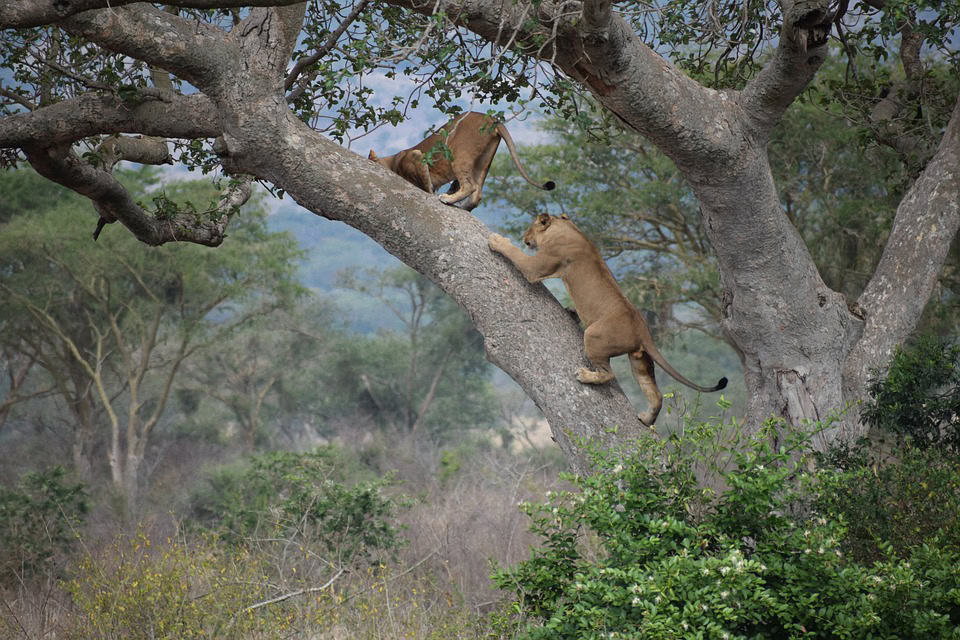
After breakfast and the return to the lodge for luggage, the drive south toward Bwindi Impenetrable National Park passes through the Ishasha sector — one of only two places in the world where lions habitually rest in the branches of trees.
The Ishasha lion prides, concentrated in the fig tree-lined corridor along the Ntungwe River in the park’s extreme southern corner, have been documented in trees since at least the 1950s, and researchers still debate why this population developed the behaviour while other savannah lion populations did not.
The game drive through Ishasha is typically productive for tree-climbing lion sightings — look into the largest spreading fig trees along the river, particularly between 8:00 a.m. and 11:00 a.m. when lions have typically finished hunting and retreated to their arboreal observation platforms.
Topis — antelope found in Uganda primarily in the Ishasha sector — graze the open grassland around the fig trees, and common warthogs trot along the tracks with tails raised in their characteristic antenna-like upright posture.
Meals: Breakfast, Lunch, and Dinner
Day 3: Bwindi Impenetrable National Park — Mountain Gorilla Trek and Lake Bunyonyi Island Boat Ride
Day 3 is the triple gorilla safari’s first gorilla encounter — the morning briefing, the forest trek, and the one extraordinary hour with a habituated mountain gorilla family in Uganda’s most ancient forest.
Gorilla Trek Briefing and Forest Entry at Bwindi
The Uganda Wildlife Authority briefing at Bwindi’s relevant sector headquarters (Buhoma in the north, Nkuringo in the southwest, Rushaga or Ruhija in the southeast depending on your accommodation location) begins by 7:30–8:00 a.m. Small groups of maximum 8 visitors are assigned to specific gorilla families based on fitness level and group composition, and ranger guides explain the protocols: maintain 7 metres distance from gorillas at all times, no flash photography, cover your face if you cough or sneeze, move slowly and follow the lead ranger’s instructions at all times.
Into the Impenetrable Forest
The word “impenetrable” is not hyperbole. Bwindi’s 331 square kilometres of ancient tropical rainforest at 1,160–2,607 metres above sea level contains an extraordinary density of vegetation — multiple canopy layers of enormous trees draped in moss and lichen, an understorey of bamboo and giant ferns, and ground cover of stinging nettles, climbing plants, and fallen logs that make navigation genuinely challenging without the guides’ route knowledge and a walking pole.
This is forest that has existed continuously for over 25,000 years, and walking through it generates a sense of temporal depth — of being inside something ancient and alive in a way that more recently disturbed landscapes cannot replicate.
Trekking time to find the gorilla family ranges from 45 minutes to 5 hours, averaging 2–3 hours for most groups. Trackers radio ahead from positions they have maintained since the gorillas’ nighttime nest sites, guiding the main group to the family’s current location.
Finding the gorilla family — a silverback back-lit by shafts of forest light, juveniles chasing each other through the undergrowth, a mother nursing an infant — is an encounter that consistently exceeds the expectations of even the most experienced wildlife travellers. One hour passes with extraordinary speed.
After the trek and certificate presentation at the park headquarters, lunch is served at the lodge before an afternoon scenic drive to Lake Bunyonyi.
Lake Bunyonyi — Uganda’s Most Beautiful Lake
Lake Bunyonyi — “the lake of many little birds” — is Uganda’s most beautiful lake and arguably one of the most visually striking places in East Africa.
Nestled in the Kigezi highlands at approximately 1,962 metres above sea level, the terraced hillsides that descend to its shores have been cultivated for generations by the Bakiga people, creating a landscape of extraordinary beauty where dense green cultivation meets the still blue water.
The lake is reportedly the second deepest in Africa, and its 29 islands — each with its own history and character — are accessible by traditional dugout canoe or motorised boat.
The afternoon Lake Bunyonyi boat ride visits the most historically significant islands: Punishment Island (Akampene), where unmarried pregnant girls were historically left to die, and Bwama Island, site of a former leprosy colony that operated until the 1960s. The cultural history of the lake provides fascinating context for what appears at first glance to be purely scenic beauty.
Lake Bunyonyi Accommodation:
- Luxury: Arcadia Cottages
- Midrange: Bunyonyi Rock Resort
- Budget: Byoona Amagara Island Retreat
Meals: Breakfast, Lunch, and Dinner
Day 4: Uganda to Rwanda — Crossing to Volcanoes National Park
Day 4 is a travel day that spans two countries, beginning with the morning drive through the Kigezi highlands and crossing from Uganda into Rwanda at either the Katuna or Cyanika border points.
The Uganda-Rwanda border crossing on this itinerary is managed by Hail Tours Uganda’s border facilitation service — included in the package — which manages the immigration formalities on both sides to minimise delay. East African Community members (Uganda, Rwanda) enjoy simplified border procedures, and the crossing typically takes 30–60 minutes.
The Rwanda side of the border reveals a different landscape character almost immediately: Rwanda’s densely cultivated hillsides are as intensively terraced as Uganda’s Kigezi, but the administrative precision and infrastructure quality visible in Rwanda’s road surface, signage, and roadside planning reflects the country’s exceptional development progress in the three decades since 1994.
The 4–5 hour drive northwest to Volcanoes National Park passes through Ruhengeri (now officially called Musanze), the regional capital and gateway town for gorilla trekking, before arriving at the park’s foothills in the late afternoon.
The Virunga volcanoes materialise through the clouds as you approach — the symmetrical cones of Karisimbi, Bisoke, and Sabinyo rising dramatically above the cultivated valley, their summits typically wreathed in cloud and their forests disappearing into the vegetation that descends to within metres of the farmland boundary.
Volcanoes National Park Accommodation:
- Luxury: Virunga Lodge or Mountain Gorilla View Lodge
- Midrange: Da Vinci Gorilla Lodge or Five Volcanoes Boutique Hotel
- Budget: Villa Gorilla or Muhabura Hotel
Meals: Breakfast, Lunch, and Dinner
Day 5: Volcanoes National Park — Second Gorilla Trek and Lake Kivu Relaxation
Day 5 delivers the second of three gorilla encounters — in Rwanda’s Volcanoes National Park, the gorilla trekking destination made globally famous by Dian Fossey and the film Gorillas in the Mist.
Rwanda Gorilla Trek Briefing at Kinigi
The Rwanda Development Board briefing at Kinigi Visitor Centre — the operational headquarters for all Volcanoes National Park gorilla trekking — begins by 7:00–7:30 a.m.
The format is similar to Uganda’s: group assignments to specific gorilla families based on fitness level, safety briefings, walking pole distribution, and the moment of eager anticipation when the families are announced and you know which of the park’s 12 habituated groups you will spend the morning tracking.
The trekking experience in Volcanoes differs from Bwindi in character rather than quality. Rwanda’s trails are generally better maintained and the terrain, while still ascending volcanic slopes, is less dramatically steep than Bwindi’s deepest forest zones.
The vegetation transitions from open farmland through bamboo forest to upper-altitude moss-draped Hagenia woodland, and the gorilla families in Volcanoes are sometimes found in open bamboo clearings that provide photography conditions more open than Bwindi’s dense forest.
After the Rwanda gorilla trek and certificate presentation, the afternoon drive to Lake Kivu provides a completely different perspective on Rwanda’s geography — the descent from the Virunga highlands to the lake shore reveals the western edge of the Great Rift Valley in dramatic fashion.
Lake Kivu — Relaxation on Rwanda’s Western Shore
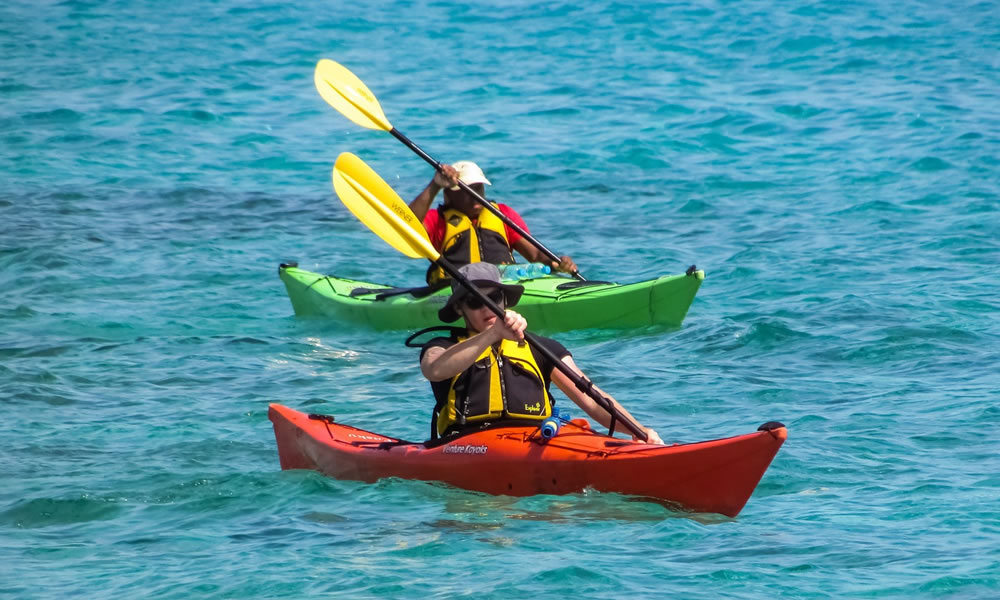
Lake Kivu is one of Africa’s Great Lakes — 2,700 square kilometres of deep water straddling the Rwanda-DRC border, embedded in the Albertine Rift Valley at 1,460 metres above sea level.
The Rwandan shore towns of Rubavu (Gisenyi) and Rusizi (Cyangugu) are Rwanda’s premier lakeside destinations, offering a relaxed rhythm of life — fishing canoes on the water, children swimming at the beach, restaurants serving freshly caught tilapia — that provides ideal recovery and reflection time after the morning’s gorilla encounter.
The afternoon at Lake Kivu is genuinely unstructured: walk the beach, sit on the lodge terrace and watch the light change on the lake’s surface, take a sunset boat ride to the nearest island, or simply experience the profound physical relief of a comfortable chair and cold drink after two consecutive days of mountain forest.
Lake Kivu Accommodation:
- Luxury: Lake Kivu Serena Hotel
- Midrange: Paradis Malahide
- Budget: Inzu Lodge
Meals: Breakfast, Lunch, and Dinner
Day 6: Rwanda to the DRC — Crossing into Virunga National Park
Day 6 takes the triple gorilla safari into its most adventurous and least-travelled leg — the crossing from Rwanda into the Democratic Republic of Congo’s Goma province and onward to Virunga National Park.
The drive from Lake Kivu south along the lakeshore to Rubavu town and the Grande Barriere border post takes approximately 1–2 hours through Rwanda’s lake district. The border crossing into DRC at Grande Barriere is the most complex of the two border crossings on this itinerary — the DRC requires a tourist visa and the specific gorilla and Nyiragongo hiking permits must be collected at the tourism office at the border building.
After border formalities and permit collection, the drive to Virunga National Park’s lodge accommodation passes through Goma City — a fascinating, chaotic urban environment built partly on the lava flows from Nyiragongo’s 2002 eruption that destroyed a significant portion of the city. The solid black lava that forms Goma’s roads and construction surface provides a visceral reminder of the active volcanic forces visible on the skyline to the north.
Virunga National Park’s accommodation cluster near the gorilla sectors is approximately 1–2 hours from Goma, and arrival in the late afternoon provides time for briefing on the following morning’s activities.
Virunga National Park DRC Accommodation:
- Luxury: Mikeno Lodge
- Midrange: Lulimbi Tented Camp or Bukima Tented Camp
- Budget: Tchegera Island Tented Camp
Meals: Breakfast, Lunch, and Dinner
Day 7: Virunga National Park — Third Gorilla Trek and Nature Walk
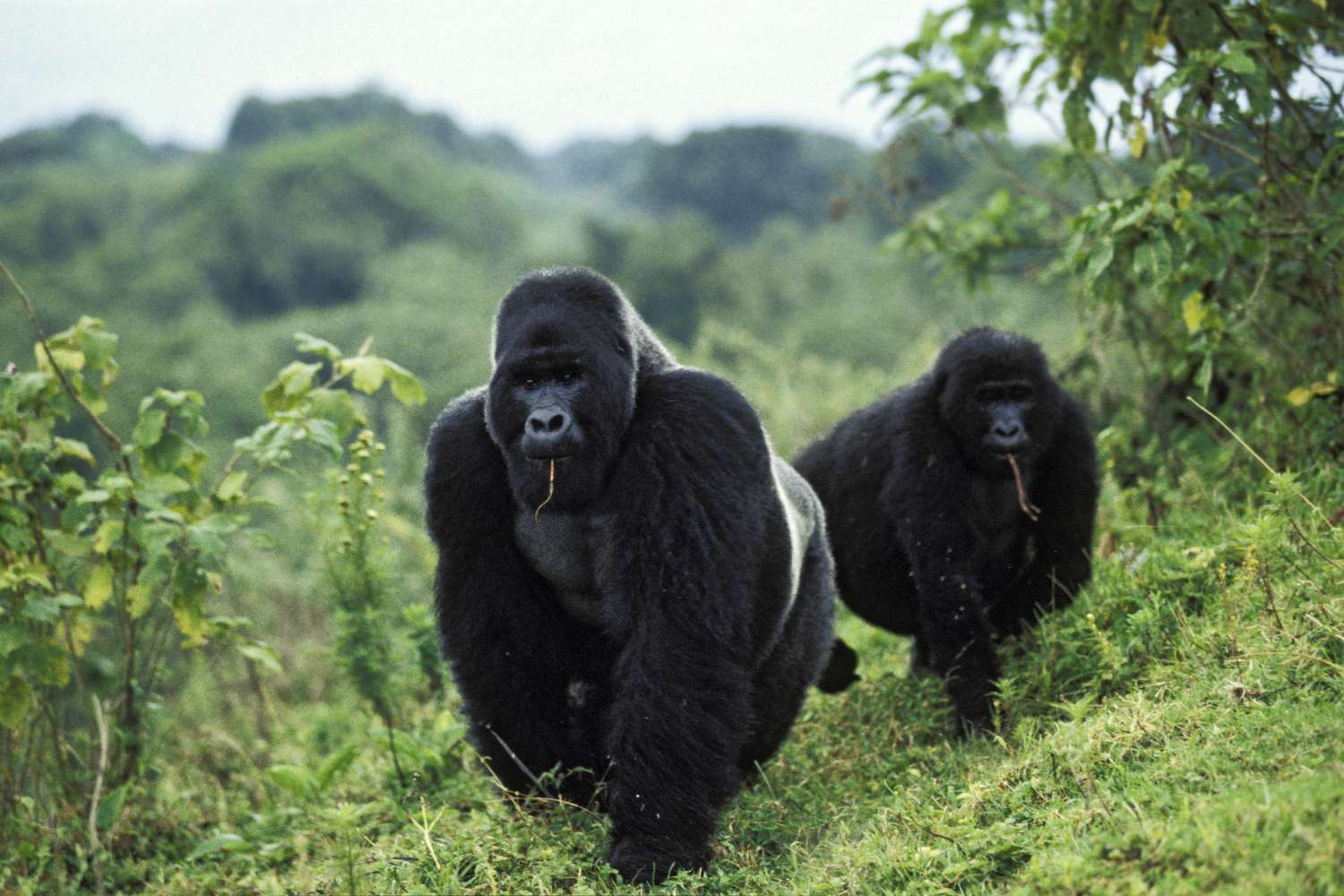
Virunga National Park is Africa’s oldest protected area — gazetted in 1925 as the Albert National Park under Belgian colonial administration — and one of the most biodiverse places on earth. The 7,800-square-kilometre park harbours not only mountain gorillas but also the only known remaining populations of Grauer’s gorillas (eastern lowland gorillas), chimpanzees, forest elephants, hippos, lions, and an extraordinary concentration of Albertine Rift endemic species.
Mountain Gorilla Trekking in Virunga
The morning gorilla trek briefing takes place at Bukima Ranger Post — the operational headquarters for Virunga’s mountain gorilla trekking sector in the volcanic highlands of the park’s southern zone.
The 8 habituated gorilla groups available for trekking in Virunga are found in a relatively small area of the southern volcanic section, and the park’s lower visitor numbers mean that each group encounters fewer people than the corresponding families in Rwanda or Uganda.
This lower visitor density is precisely what makes the Virunga gorilla experience feel distinctly different from both Bwindi and Volcanoes — the sense of a more private, more intimate encounter that is less shaped by safari infrastructure and more shaped by the raw forest environment.
The DRC’s more challenging context means that fewer tourists reach this park, and the result is a genuinely remote quality that is increasingly rare in modern gorilla tourism.
After the gorilla trek and the third trekking certificate — completing the full set from all three countries — the afternoon is devoted to a guided nature walk through Rumangabo Park Headquarters, where Virunga’s biodiversity extends well beyond the gorillas.
Bird species endemic to the Albertine Rift accumulate rapidly on the walk list, and the option to visit Virunga’s bamboo conservation project provides context for the park’s broader conservation work.
Meals: Breakfast, Lunch, and Dinner
Day 8: Mount Nyiragongo Hike — Ascending the World’s Most Accessible Active Lava Lake
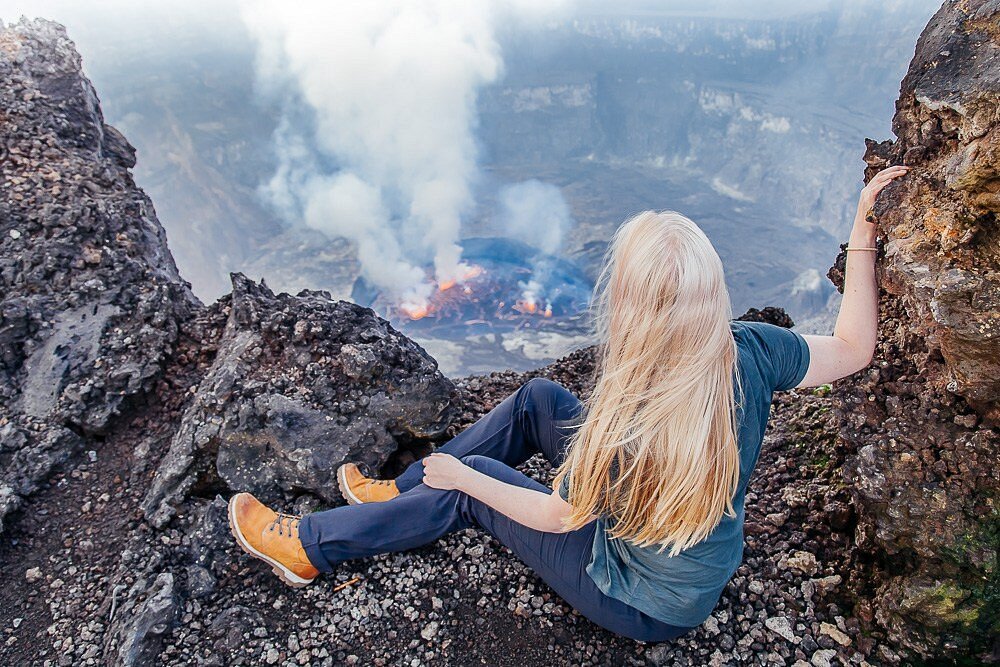
Mount Nyiragongo is one of the world’s most extraordinary volcanoes — an active stratovolcano whose crater holds the largest permanent lava lake on earth, a churning pool of molten rock that glows red against the dark sky in one of nature’s most primal displays of geological power.
The volcano last erupted in May 2021, sending lava flows through the streets of Goma and into Lake Kivu, and its ongoing activity means that the lava lake — observed from the crater rim at 3,470 metres above sea level — is visible virtually every night when atmospheric conditions cooperate.
The Ascent
The Mount Nyiragongo hike begins with a briefing at Kibumba Ranger Post at the volcano’s base, typically starting by 10:00 a.m. to allow a leisurely ascent timed for arriving at the summit camp before dark.
The hike covers approximately 5 kilometres of vertical gain, ascending through successive vegetation zones — from the Hagenia-dominated lower slopes through a moorland of tree heathers and giant senecios to the bare volcanic rock of the upper cone.
The ascent is conducted in phases, with rest stops at designated points and ranger guides managing the group pace. Altitude effects — shortness of breath, increased heartbeat, mild headache — are common above 3,000 metres and require conscious management of pace and hydration.
The physical challenge of the Nyiragongo ascent is real but manageable for most reasonably fit travellers who pace themselves appropriately.
The Summit Experience
Arrival at the summit crater rim in the late afternoon reveals the experience that makes every metre of the ascent worthwhile: a crater approximately 250 metres deep and 400 metres wide whose floor holds the world’s largest permanent lava lake — a roiling, churning pool of molten rock whose surface shifts constantly, bubbles, and fractures in patterns that are simultaneously terrifying and mesmerising. At night, the lava lake glows red against the dark sky in a display that no photographic medium fully captures.
The overnight shelters at the Nyiragongo summit — basic corrugated metal structures at the crater rim — provide beds, blankets, and meals delivered by porter teams who made the ascent alongside the trekking group.
Sleeping at 3,470 metres in metal shelters while a lava lake churns 250 metres below is an experience that sits in the extraordinary category by any standard.
Meals: Breakfast, Lunch, and Dinner
Day 9: Mount Nyiragongo Descent and Transfer to Kigali
The descent from Mount Nyiragongo — taking approximately 3–4 hours — moves faster than the ascent as the downhill gradient allows a more confident pace and the vegetation zones pass in reverse.
Porters who carried equipment up the mountain carry it down, and the morning light on the Virunga landscape from the descent path reveals the full extent of the volcanic terrain — Nyiragongo, Nyamuragira, and the distant Virunga cones stretching across the horizon in a chain of ancient geological violence and extraordinary beauty.
After the descent and final permits are surrendered at Kibumba, the 4-hour drive through Goma, across the DRC-Rwanda border at Grande Barriere, and north through Rubavu and Musanze toward Kigali brings the 9-day triple gorilla safari to its conclusion.
Arrival at Kigali Airport or your Kigali hotel in the late afternoon closes the loop on an itinerary that began nine days earlier in Uganda and has crossed three countries, three national parks, three gorilla populations, and one active volcano.
Meals: Breakfast and Lunch
End of the 9 Days Uganda Rwanda Congo Gorilla Trek .
What Is Included and Not Included in the 9 Days Uganda Rwanda Congo Gorilla Trek Package.
Fully Included:
- 3 mountain gorilla trekking permits: Uganda Bwindi (USD 800), Rwanda Volcanoes (USD 1,500), DRC Virunga (USD 400)
- Mount Nyiragongo hiking permit (DRC)
- All national park entrance fees (Queen Elizabeth Uganda, Bwindi Uganda, Volcanoes Rwanda, Virunga DRC)
- Uganda–Rwanda border crossing facilitation
- Rwanda–DRC border crossing facilitation and permit collection
- Kazinga Channel boat cruise (Queen Elizabeth National Park)
- Lake Bunyonyi island boat ride
- Lake Kivu afternoon boat ride and relaxation
- Virunga nature walk at Rumangabo
- Nyiragongo summit overnight accommodation and meals
- 8 nights’ accommodation per the itinerary (excluding summit shelter)
- All meals as specified: Days 1–8 (full board); Day 9 (breakfast and lunch)
- Transport in dedicated 4WD safari vehicle throughout Uganda
- Rwanda and DRC ground transport for the relevant legs
- Services of an experienced driver-guide
- Bottled water throughout
- Hotel pick-up (Kampala or Entebbe) and final drop-off (Kigali Airport or hotel)
- All relevant government taxes
Not Included:
- International flights to Uganda and from Rwanda (or vice versa)
- Uganda, Rwanda, and DRC tourist visas (apply in advance)
- Travel and comprehensive medical insurance (essential for this itinerary)
- Gorilla trek porter fees (optional but strongly recommended especially for Bwindi and Virunga)
- Nyiragongo porter fees (strongly recommended)
- Personal expenses: laundry, beverages beyond water, telephone, souvenirs, cigarettes
- Tips and gratuities for driver-guides, rangers, and lodge staff (discretionary)
- Optional activities not listed in the itinerary
Why This Is the Ultimate Gorilla Trek Safari
Most gorilla trekking visitors choose one park in one country. Those who have done all three describe the triple gorilla trekking experience as transformative — not because the gorillas differ fundamentally in behaviour across the three parks, but because the three forests, three landscapes, and three trekking experiences are each so distinct that combining them illuminates mountain gorilla ecology in a way no single encounter can.
Three Gorilla Forests — Three Completely Different Experiences
Bwindi Impenetrable National Park (Uganda) delivers what many experienced gorilla trekking travellers describe as the most emotionally immersive experience of the three. Bwindi’s ancient tropical rainforest — one of the oldest forests in Africa, surviving all ice ages intact due to its position as a Pleistocene refugium — has a quality of deep, cathedral silence beneath its multiple-canopy structure.
The terrain is genuinely challenging: steep volcanic ridges, dense stinging nettles, root systems and fallen logs across the trails, and the specific physical memory of earning your position in front of a silverback through 2–4 hours of forest navigation.
Volcanoes National Park (Rwanda) is the most celebrated and most visited gorilla trekking destination in the world, where Dian Fossey spent 18 years at the Karisoke Research Centre establishing the foundation of mountain gorilla science.
Rwanda’s park is more accessible than Bwindi — better-maintained trails, shorter average trek times, and the dramatic visual backdrop of the Virunga volcanic peaks making the landscape unmistakably different from Bwindi’s dense equatorial forest.
The habituation of Rwanda’s gorilla families is among the most established on earth, and the encounters here have a particularly relaxed quality as families go about their day with minimal concern for the visitors at close range.
Virunga National Park (DRC) is the oldest national park in Africa, gazetted in 1925, and the gorilla trekking experience here is described by those who have done all three as the most raw, the most private, and the most authentically remote.
Fewer visitors, less-developed infrastructure, and the tangible sense of being in a more genuinely wild environment create an encounter whose emotional impact matches anything in Bwindi or Volcanoes.
For travellers wanting an extended exploration of either Uganda or Rwanda gorilla parks before undertaking the triple, the 9 Days Gorilla Trek in Uganda and 8 Days Rwanda Gorilla Trekking provide single-country depth.
Mountain Gorilla Trekking Compared: Uganda vs Rwanda vs Congo
One of the most common questions from travellers planning the triple gorilla safari is how the three experiences compare — and the honest answer is that they are complementary rather than competitive.
Bwindi Impenetrable National Park, Uganda
Permit cost: USD 800 per person (updated from the original article’s outdated USD figure) Number of habituated groups: Over 21 Average trek time: 2–5 hours Terrain: Steep, dense, ancient tropical forest Forest character: Equatorial rainforest at 1,160–2,607m; oldest forest in the region What makes it unique: The most immersive and physically challenging of the three; the rarest sense of genuine wilderness; the deepest forest experience Best for: Adventurous trekkers who want maximum physical engagement with the forest
The Bwindi Impenetrable National Park page provides comprehensive information on all four trekking sectors, gorilla family profiles, and accommodation options at each sector.
Volcanoes National Park, Rwanda
Permit cost: USD 1,500 per person Number of habituated groups: 12 Average trek time: 1–4 hours Terrain: Volcanic slopes through bamboo and Hagenia forest Forest character: Afro-montane with bamboo zone, more open than Bwindi What makes it unique: Most celebrated destination (Dian Fossey legacy); most accessible and best organised; dramatic Virunga volcanic backdrop Best for: First-time gorilla trekkers, less physically mobile travellers, photography in more open terrain
The Volcanoes National Park Rwanda page covers all aspects of the Rwanda gorilla trekking experience.
Virunga National Park, DRC
Permit cost: USD 400 per person Number of habituated groups: 8 Average trek time: 1–5 hours Terrain: Volcanic slopes; mixed forest and bamboo; variable Forest character: Afro-montane; similar to Volcanoes but lower visitor infrastructure What makes it unique: Most remote and private; lowest visitor numbers; cheapest permit; raw and authentic; combined with Nyiragongo for a unique volcanic adventure Best for: Adventurous travellers seeking the least-touristed gorilla experience; those combining with Nyiragongo hiking
Gorilla Trekking Permit Comparison
| Country | Park | Permit Cost (USD) | Max Visitors/Group | Trek Duration |
|---|---|---|---|---|
| Uganda | Bwindi / Mgahinga | $800 | 8 | 1–6 hours |
| Rwanda | Volcanoes NP | $1,500 | 8 | 1–4 hours |
| DRC | Virunga NP | $400 | 8 | 1–5 hours |
All three gorilla permits are included in the Hail Tours Uganda 9-day triple gorilla safari package.
Mount Nyiragongo: Everything You Need to Know Before the Hike
The Mount Nyiragongo hike is the most physically demanding activity on the 9-day itinerary and the most geologically extraordinary. Here is comprehensive preparation guidance.
Altitude and Physical Requirements
Mount Nyiragongo rises to 3,470 metres above sea level. Most trekkers experience some altitude effects — shortness of breath, increased pulse rate, mild headache — above 3,000 metres. The hike is not technically challenging (no climbing equipment required), but the steep gradient and altitude combine to make it moderately strenuous. Travellers with heart conditions, severe respiratory conditions, or significant mobility limitations should consult their doctor before committing to the Nyiragongo hike.
What to Wear and Bring for Nyiragongo
- Warm layers including a fleece jacket and windproof outer layer (summit temperatures can drop below 5°C at night)
- Waterproof jacket (rain is frequent on the volcanic slopes)
- Sturdy hiking boots with ankle support
- Walking poles (available from park rangers at Kibumba — strongly recommended)
- Headlamp with spare batteries (the summit shelter area is dark after sunset)
- 2–3 litres of water for the ascent; bottled water is available from porters at the summit
- High-calorie snacks for energy during the ascent
- Camera with extra batteries (cold temperatures drain batteries faster at altitude)
Porter Services at Nyiragongo
Porters at Kibumba Ranger Post carry packs up and down the volcano and provide valuable physical support on difficult terrain sections. Hiring a porter is strongly recommended — it supports local economic benefit from the park and provides practical assistance on a demanding ascent.
Physical and Mental Preparation for the Triple Gorilla Safari
This 9-day safari is the most physically demanding gorilla trekking itinerary available — three separate gorilla treks in three different countries, plus a full-day volcano hike, all within nine days. Preparing both physically and mentally significantly enhances the experience.
Physical Preparation
Begin a 6–8 week preparation programme before the safari. Weekly hikes on uneven terrain are the most directly relevant training — the specific combination of slope, irregular footing, and sustained aerobic effort closely mimics gorilla trekking conditions.
A weekly Saturday or Sunday half-day hike of 3–4 hours on moderately steep terrain builds exactly the cardiovascular and muscular endurance required. Supplementary activities including cycling, swimming, and gym work build the baseline aerobic capacity that complements specific hiking preparation.
Core strength — particularly lower back and abdominal stability — is important for navigating Bwindi’s steep terrain, where the body repeatedly stabilises against root systems and uneven surfaces.
Basic core exercises performed daily in the weeks before departure make a genuine difference to comfort and stability on the mountain.
Mental Preparation
The triple gorilla safari requires patience above all — gorilla trekking involves committing to however long the forest search takes, without knowing in advance whether that will be 45 minutes or 5 hours.
Cultivating a mindset that treats the forest journey itself as an experience worth having — the birds, the vegetation, the sounds, the physical challenge — rather than merely an obstacle between you and the gorillas is the mental approach that produces the most satisfying overall experience.
The Nyiragongo hike similarly requires the patience to maintain a steady pace through the altitude effects of the upper mountain, trusting that the summit experience justifies the discomfort.
The rangers and guides have extensive experience managing the pace for mixed groups, and their guidance on when to rest and when to push is calibrated by thousands of previous ascents.
Lake Bunyonyi: Uganda’s Most Beautiful Lake
Lake Bunyonyi deserves more than a brief overnight stop, and travellers who discover it here often return specifically for extended lake time on future Uganda visits. The lake — whose name means “place of many small birds” in Rukiga — sits at 1,962 metres above sea level in the Kigezi highlands of southwestern Uganda, ringed by terraced hillsides that have been cultivated by the Bakiga people for generations.
The 29 islands of Lake Bunyonyi each carry their own historical layer — some inhabited by fishing communities, some containing ancient ruins, some with extraordinary bird concentrations (the lake supports over 200 bird species including the African green broadbill and numerous waterbirds). Traditional dugout canoe paddling and motorised island-hopping are both available from the lake lodges.
Bunyonyi is bilharzia-free and safe for swimming — a rare combination for a Ugandan lake — and the evening on the lake, watching the terraced hillsides glow gold and then purple as the sun sets behind the western escarpment, is one of the most peaceful experiences in East Africa’s safari circuit.
The 4 Days Bwindi Gorillas and Lake Bunyonyi Safari is the natural short itinerary pairing these two southwestern Uganda experiences for travellers who want to spend more time at the lake.
Best Time for the Triple Gorilla Trek: Uganda, Rwanda, and Congo
Gorilla trekking is available every day of every month in all three countries — the gorillas are present year-round and habituated families are tracked daily regardless of season. However, seasonal considerations affect comfort and logistics.
Dry Seasons (June–September and December–February)
The two dry seasons provide the most comfortable trekking conditions in all three countries — drier trails, better visibility, firmer underfoot conditions on slopes, and generally more predictable weather.
These are the peak demand periods and gorilla permits book out months in advance. The Nyiragongo summit is also more likely to be cloud-free in dry season, improving the lava lake visibility.
Rainy Seasons (March–May and October–November)
The long rains (March–May) and short rains (October–November) bring more challenging trekking conditions — muddy trails, wet vegetation, and cooler mountain temperatures — but also dramatically beautiful forest atmosphere and lower visitor numbers.
Many experienced gorilla trekking travellers prefer the rainy season for the increased forest atmosphere and the possibility of more relaxed gorilla family encounters in the wetter conditions when families rest rather than travel.
For a comprehensive seasonal guide, the gorilla trekking Rwanda and Uganda Gorilla Trekking pages provide detailed monthly guidance.
FAQs: 9-Day Triple Gorilla Trek
Is it safe to visit Virunga National Park in the DRC? Virunga National Park’s tourist zones — particularly the gorilla trekking sectors and Nyiragongo hiking routes — have operated safely for international visitors for many years with a strong security infrastructure of park rangers and military escorts. Hail Tours Uganda monitors security conditions continuously and only operates to Virunga when the current security situation permits. Travellers should purchase comprehensive travel insurance that includes DRC coverage. The Virunga Conservation Authority’s own website provides the most current security status information.
How much do the three gorilla permits cost combined? The three gorilla permits on this itinerary total USD 2,700 per person: Uganda Bwindi at USD 800, Rwanda Volcanoes at USD 1,500, and DRC Virunga at USD 400. All three permits are included in the Hail Tours Uganda 9-day package price.
Do I need separate visas for Uganda, Rwanda, and Congo? Uganda and Rwanda offer an East African Tourist Visa (USD 100) that covers both countries in a single multiple-entry visa — confirm eligibility for your nationality. The DRC requires a separate tourist visa obtained in advance from a DRC embassy. Confirm current visa requirements for your nationality with Hail Tours Uganda before departure.
How does the Nyiragongo hike compare in difficulty to gorilla trekking? The Nyiragongo hike is generally considered more physically demanding than any of the three gorilla treks because of the sustained altitude gain, the altitude effects above 3,000 metres, and the duration (approximately 4–5 hours up, 3–4 hours down).
However, it is not technically difficult — no climbing equipment is required, and the volcanic slope gradient is consistent.
The gorilla treks involve more varied terrain and shorter but more physically intense bursts of effort on Bwindi’s steep slopes.
Can I extend this itinerary to include Rwanda’s golden monkey trekking? Yes — golden monkey tracking in Volcanoes National Park can be added to the Rwanda portion of this itinerary as an afternoon activity on Day 4 or an additional morning activity before the gorilla trek on Day 5. The 3 Day Gorilla & Golden Monkey Trekking Rwanda provides a standalone Rwanda itinerary covering both species.
Book Your 9-Day Triple Gorilla Safari with Hail Tours Uganda
Hail Tours Uganda is the experienced East Africa safari operator that makes the 9-day Uganda Rwanda Congo triple gorilla trek manageable — handling all three gorilla permit applications across three countries, both border crossings, DRC permit collection logistics, Nyiragongo permits, and the seamless coordination of accommodation, transport, and guiding that this complex itinerary requires.
This is the most demanding and the most extraordinary gorilla safari itinerary in the world. Contact Hail Tours Uganda today to confirm availability of permits in all three countries on your preferred dates — permits must be secured well in advance — and to receive a personalised quote for this once-in-a-lifetime triple gorilla trek adventure.
Related Safari Packages Worth Exploring
- 9 Days Gorilla Trek in Uganda — Extended single-country Uganda gorilla trek covering more parks and primate experiences
- 8 Days Uganda Rwanda Safari — The two-country combination of Uganda and Rwanda gorilla trekking and wildlife without the DRC leg
- 8 Days Rwanda Gorilla Trekking — Comprehensive 8-day Rwanda gorilla and wildlife safari
- 5 days Rwanda Congo Gorilla Safari — Focused 5-day Rwanda-DRC gorilla trek combining Volcanoes and Virunga
- 4 Days Double Gorilla Trekking — Two consecutive gorilla treks in Uganda’s Bwindi in 4 days
- 4 Days Bwindi Gorillas and Lake Bunyonyi Safari — The Bwindi and Lake Bunyonyi combination in a focused 4-day itinerary
- 7 days Uganda Rwanda Wildlife Safari — 7-day cross-border safari combining gorillas and wildlife in Uganda and Rwanda
- 3 Day Gorilla Trekking Uganda — Shortest Uganda gorilla trek itinerary
- 3 Day Gorilla & Golden Monkey Trekking Rwanda — Adds Rwanda’s golden monkey trekking to the gorilla experience
- 5 Days Uganda Rwanda Gorilla Trek — Cross-border gorilla trek in 5 days combining Bwindi and Volcanoes
- 4 Days Flying Gorilla Safari Uganda — Fly in and out of Bwindi for maximum experience in minimum time
- 5 Day Rwanda Primate Safari — 5-day Rwanda primate itinerary with gorillas, golden monkeys, and chimpanzees
- 10 Days Uganda Gorilla and Wildlife Safari — Extends Uganda gorilla trekking with chimpanzees and wildlife
- 14 days Uganda primates and wildlife safari — The most comprehensive Uganda primate and wildlife combination
- Bwindi Impenetrable National Park — Complete guide to Uganda’s premier gorilla trekking destination
- Volcanoes National Park Rwanda — Comprehensive guide to Rwanda’s Volcanoes National Park gorilla trekking
- Queen Elizabeth National Park — Full guide to Uganda’s most biodiverse national park including the Kazinga Channel
- Uganda Gorilla Trekking — Complete guide to gorilla trekking across Uganda’s parks
- Gorilla Trekking Rwanda — Everything you need to know about Rwanda gorilla trekking and permit booking
- 18 Days African Safari — The ultimate multi-country East Africa safari that expands this 9-day framework
- About Hail Tours Uganda — The East Africa safari specialists behind your triple gorilla adventure
- Contact Hail Tours Uganda — Book your 9-day triple gorilla trek in Uganda, Rwanda, and Congo today