
8 Days Tanzania Budget Safari 2026 — Serengeti, Ngorongoro, Tarangire & More
This 8 Days Tanzania Budget Safari covers four of Tanzania’s most iconic destinations on the Northern Circuit — Tarangire National Park, Serengeti National Park, Ngorongoro Conservation Area, and Lake Eyasi — with a closing game drive in Lake Manyara National Park, all while staying in comfortable, carefully selected budget safari lodges and camps that deliver genuine value without sacrificing the quality of your wildlife encounter.
This is an eight-day itinerary built for travellers who understand that the quality of an African safari is measured by what you see and experience in the field — not by the thread count of your lodge linen.
Expert professional guides, reliable 4×4 safari vehicles with game-viewing roofs, full board accommodation, and access to Tanzania’s most celebrated wildlife destinations are all included in this affordable Tanzania safari package starting and ending in Arusha, the gateway city of the Northern Circuit.
For travellers considering longer or more luxurious Tanzania options, our 7 Days Luxury Tanzania Safari, 5 Days Serengeti and Ngorongoro Safari, and 9 Days Tanzania Wildlife Safari provide alternatives at different durations and price points.
Why the Tanzania Northern Circuit Is Africa’s Best Wildlife Safari Route
The Tanzania Northern Circuit is the most wildlife-rich safari route on the African continent — a connected series of national parks, conservation areas, and crater landscapes that delivers Big Five sightings, the Great Migration, volcanic geology, indigenous cultural encounters, and flamingo-pink soda lakes within a geographically compact arc of destinations that can be toured comfortably in eight days.
Serengeti National Park — covering 5,700 square miles of open savannah and riverine forest — is Tanzania’s most celebrated wildlife area and one of the world’s great protected ecosystems, hosting the annual wildebeest and zebra migration that involves over 1.5 million animals.
Ngorongoro Crater is arguably Africa’s greatest single wildlife viewing arena: a 2,000-square-kilometre volcanic caldera whose steep walls function as a natural enclosure, trapping extraordinary concentrations of lion, leopard, black rhinoceros, elephant, and buffalo on its crater floor.
Tarangire National Park delivers Africa’s highest elephant density during the dry season alongside landscape-defining ancient baobab trees that no other Tanzanian park can match.
Lake Eyasi provides a window into one of Tanzania’s last hunter-gatherer communities — the Hadzabe — living a lifestyle largely unchanged for thousands of years.
And Lake Manyara National Park closes the circuit with its famous tree-climbing lions, dense flamingo populations, and compact, rewarding half-day game drive.
Together, these destinations make the Tanzania Northern Circuit not just Africa’s most famous safari route but its most consistently productive for the full range of experiences that define what a great African safari actually is.
8 Days Tanzania Budget Safari — Tour Highlights
- Arusha city tour— cultural and historical orientation in Tanzania’s safari capital, including the Central Market, Natural History Museum, and the Tanzanite Experience
- Tarangire National Park— Africa’s highest elephant density plus giant baobab trees, lions, leopards, and over 550 bird species in an underrated Northern Circuit gem
- Olduvai Gorge (Oldupai Gorge)— the “Cradle of Mankind” where Louis and Mary Leakey discovered evidence of the earliest human ancestors; an unmissable paleoanthropology stopover en route to the Serengeti
- Serengeti National Park game drives— two full days targeting lions, cheetahs, elephants, wildebeest, zebra, and the Great Migration in one of the world’s greatest wildlife habitats
- Serengeti walking safari and village walk— experiencing the Serengeti on foot and meeting the human communities living alongside this extraordinary ecosystem
- Ngorongoro Crater floor game drive— the world’s most concentrated Big Five arena, including one of Africa’s best opportunities to see black rhinoceros in the wild
- Lake Eyasi Hadzabe cultural encounter— spending a morning with one of Tanzania’s last hunter-gatherer tribes; an experience of genuine anthropological depth
- Lake Manyara National Park— tree-climbing lions, enormous flamingo flocks, and excellent birding in a compact park that punches above its weight in wildlife diversity
Brief 8 Days Tanzania Budget Safari Itinerary
- Day 1: Arrive in Tanzania-Experience Arusha’s culture and History.
- Day 2: Drive to Tarangire National Park-explore the untouched wilderness of this Protected Area.
- Day 3: Short Tarangire game drive and journey to Serengeti National Park.
- Day 4&5: Serengeti National Park: Explore the wilderness via game drives, walking safari, and community visits.
- Day 6: Drive from Serengeti to the breathtaking Ngorongoro Conservation Area.
- Day 7: Guided Lake Eyasi Tour.
- Day 8: Half-day Lake Manyara game drive and departure.
Detailed Itinerary — 8 Days Tanzania Budget Safari
Day 1: Arrival in Arusha — Tanzania’s Safari Gateway City
Your 8-day Tanzania budget safari begins at Kilimanjaro International Airport near Moshi — approximately 45 kilometres from Arusha Town — where your Hail Tours representative meets you at arrivals with a welcome board and assists with the transfer to your Arusha hotel.
The drive from Kilimanjaro Airport to Arusha takes approximately 40–50 minutes through the agricultural outskirts of the city, with views of Mount Kilimanjaro itself occasionally visible to the east on clear mornings — a 5,895-metre white-capped giant that puts the drama of what lies ahead into immediate, humbling perspective.
Arusha is the undisputed capital of Tanzania’s Northern Circuit safari industry — a city of approximately 400,000 people that functions as the organisational hub for wildlife tourism across the entire northern region.
It is a genuinely interesting and culturally rich city in its own right, and the afternoon of Day 1 provides an excellent opportunity for unhurried exploration that sets the cultural and historical context for the wildlife experiences to come.
The Arusha Central Market is the city’s most vibrant and sensory public space — a dense, colourful market where fresh produce, spices, fabrics, and crafts from across the Arusha region are bought and sold in a cross-tribal, cross-cultural atmosphere that gives a real sense of the human diversity of northern Tanzania.
The Arusha National Natural History Museum provides important geological and anthropological context — particularly relevant for the Olduvai Gorge visit on Day 3 — with exhibits on the Rift Valley’s role in human evolution and the region’s complex ecology.
The Tanzanite Experience — a visitor centre dedicated to the rare blue gemstone found only in the Merelani Hills near Arusha — is a worthwhile stop for anyone interested in the mineralogical dimension of Tanzania’s extraordinary geological landscape.
The evening briefing with your guide covers the full eight-day safari plan, packing recommendations for each destination, and the specific wildlife priorities for the following day’s Tarangire game drive.
Accommodation Options: – Mid-range: Fun Retreat Resort, Fairmont Hotel – Comfort option: Paradise Lodge
Meals: Breakfast, Lunch, Dinner
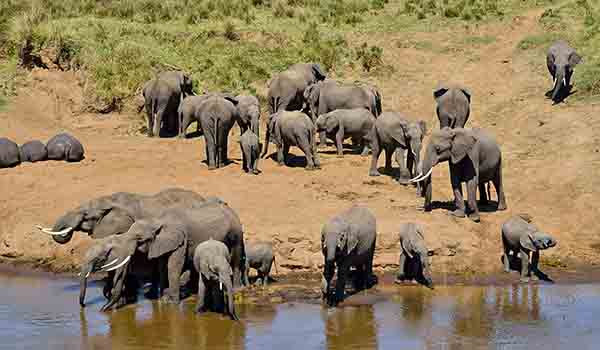
Day 2: Tarangire National Park — Elephants, Baobabs, and Hidden Safari Wilderness
An early departure from Arusha heads southwest to Tarangire National Park — a three-hour drive that passes through the Maasai steppe and arrives at one of Tanzania’s most underrated and genuinely spectacular wildlife destinations.
Despite being one of the Northern Circuit’s established parks, Tarangire receives significantly fewer visitors than Serengeti or Ngorongoro, which means you will often have remarkable wildlife encounters with no other vehicles in sight — a rare and precious experience in Tanzania’s most visited region.
Covering 2,850 square kilometres of diverse ecosystems — open grassland, swamp, riverine forest, and the iconic ancient baobab tree landscape that defines Tarangire’s visual identity — this park delivers wildlife experiences that frequently surprise first-time visitors who arrived expecting something overshadowed by the Serengeti.
Tarangire is home to Africa’s highest dry-season elephant concentration, with hundreds and sometimes thousands of elephants converging on the permanent Tarangire River during the June–October dry season when water sources elsewhere in the region disappear. Seeing 200 elephants at a single waterhole is not an unusual Tarangire experience.
Beyond elephants, Tarangire protects impressive populations of lions, leopards, cheetahs, Cape buffalo, Maasai giraffe, wildebeest, zebra, impala, Kirk’s Dik-dik, olive baboon, vervet monkey, and caracal — plus over 550 recorded bird species making it one of Tanzania’s most productive birding destinations.
The park’s famous giant baobab trees, some estimated to be over 1,000 years old, frame every game drive with a landscape of genuinely extraordinary visual power.
A picnic lunch in the field — one of the classic pleasures of African safari travel — is served in the open savannah before the afternoon game drive continues through the park’s most productive sectors.
Accommodation Options: – Budget: Whistling Thorn Tented Camp, Tarangire Simba Lodge
Meals: Breakfast, Lunch, Dinner
Day 3: Morning Tarangire Game Drive — Olduvai Gorge — Serengeti National Park
The morning of Day 3 offers a final circuit through Tarangire National Park to search for species missed during the previous day’s drive — leopards in the riverine acacia trees, cheetahs on open grassland termite mounds, and the lions that patrol Tarangire’s reed-lined river banks are all worth a second morning’s patient searching before the day’s main journey north begins.
The mid-morning departure heads northwest toward the Serengeti, with one of Tanzania’s most remarkable historical and scientific stopovers breaking the journey: Olduvai Gorge — now officially called Oldupai Gorge — in the Great Rift Valley’s eastern edge.
This 50-metre deep ravine cut through ancient volcanic ash layers is one of the most important paleoanthropological sites in the world — the place where British-Kenyan archaeologists Louis and Mary Leakey discovered fossils of early human ancestors including Homo habilis (1960) and Australopithecus boisei (1959), pushing the known timeline of human evolution back by millions of years.
A visit to the Olduvai Gorge Museum brings this extraordinary scientific heritage to life with fossil specimens, geological cross-sections, and exhibits on the Leakeys’ decades of research in this landscape.
From Olduvai, the road continues north into the Serengeti — the landscape opening progressively as you cross the Ngorongoro Conservation Area boundary and descend onto the Serengeti plains proper, where the sheer scale and openness of this ecosystem delivers an immediate, visceral impression even before the first animal is spotted.
Arrive at your Serengeti camp in time for sunset, dinner, and the incomparable sound of lions calling across the plains at night.
Accommodation Options: – Budget: Zawadi Serengeti Camp, Serengeti Pure Tented Camp
Meals: Breakfast, Lunch, Dinner
Day 4: Full-Day Serengeti Game Drive — Great Migration, Big Five, and Open Plains Drama
Serengeti National Park covers 14,763 square kilometres of open savannah, riverine forest, kopje (rocky outcrop) habitat, and seasonal wetland — one of the largest and least fragmented savannah ecosystems on earth, continuously connected with Kenya’s Masai Mara National Reserve across the international border to create an unbroken wildlife corridor of almost unimaginable scale.
Its name derives from the Maasai word Siringet — “endless plains” — and standing at the edge of Serengeti’s central plains on a clear morning, looking to a horizon with no fence, no road, and no human structure visible in any direction, the aptness of that name is immediately apparent.
The Serengeti Great Migration is the defining wildlife event of the Tanzania safari calendar — approximately 1.5 million wildebeest and several hundred thousand Burchell’s zebra and Thomson’s gazelle moving continuously in a clockwise circuit across the Serengeti and Masai Mara ecosystems in response to seasonal grass growth.
The migration is a year-round event with different phases: calving season on the southern Serengeti plains in January–February, the movement northward through the central and western Serengeti in March–June, the dramatic Mara River crossings in July–October when crocodile-filled waters are negotiated by thousands of animals simultaneously, and the return south in November–December. Every month offers a different aspect of this extraordinary ecological phenomenon.
Beyond the migration, Serengeti’s resident Big Five population is exceptional. Lion prides are among the most studied and accessible in Africa — the Serengeti lion research programme has run continuously since 1966, and some individual prides are so well-habituated to vehicles that they sleep within metres of stationary 4×4s. Leopards rest in umbrella thorn acacia trees along seasonal drainage lines.
Cheetahs hunt on the open plains in broad daylight. Elephants move in multi-generational family herds across the western corridor. And Cape buffalo congregate in enormous aggregations in the valley grasslands.
A full day in the Serengeti with an expert guide and a game-viewing vehicle produces wildlife encounters that accumulate into something genuinely extraordinary — a day in which the Big Five, cheetah, wild dog, hyena, jackal, and hundreds of bird species may all be recorded.
Accommodation: As Day 3 Meals: Breakfast, Lunch, Dinner
Day 5: Serengeti Walking Safari & Village Community Walk
Day 5 shifts the Serengeti experience from vehicles to feet — delivering two perspectives on this ecosystem that game drives alone cannot provide.
The guided Serengeti walking safari begins in the early morning when temperatures are cool, predators are moving, and the birds are at their most active. Walking in the Serengeti with an armed ranger guide is a fundamentally different experience from driving: every track in the dust carries meaning, every sound in the grass carries weight, and the relationship between you and the landscape changes completely when you move through it at ground level rather than above it in an elevated vehicle.
Walking safari guides identify animal tracks, examine dung for age and species, explain the ecological relationships between plant communities and grazers, and locate species — particularly smaller mammals, reptiles, and birds — that are invisible from a vehicle.
The Serengeti walking safari is not a replacement for game drives but a complement that transforms your understanding of what you have been watching from the car.
The afternoon village community walk brings the human dimension of the Serengeti ecosystem into focus — meeting Maasai and Kurya community members whose cattle-herding traditions and agricultural livelihoods exist at the interface with the park boundary.
Understanding how local communities relate to wildlife — both the genuine benefits of tourism revenue and the very real challenges of crop-raiding elephants and cattle-killing lions — adds essential context to the conservation story of the Serengeti. Community visits here are authentic, respectful exchanges facilitated by your guide rather than staged performances for tourists.
Accommodation: As Day 3 Meals: Breakfast, Lunch, Dinner
Day 6: Serengeti to Ngorongoro Crater — Floor Game Drive
After breakfast, depart the Serengeti heading east toward one of Africa’s most extraordinary geological and ecological wonders: Ngorongoro Crater, a UNESCO World Heritage Site and the world’s largest intact volcanic caldera.
The drive from the Serengeti takes you back across the Ngorongoro Conservation Area’s highland plateau, with views from the crater rim — at over 2,300 metres elevation — down into the 600-metre deep volcanic bowl that contains one of Africa’s most concentrated and remarkable wildlife populations.
Ngorongoro Crater covers 3,202 square miles of enclosed savannah, swamp, and lake habitat within the caldera walls, harbouring an estimated 25,000 large animals in a self-contained ecosystem from which most inhabitants never leave.
The crater floor’s permanent water supply in Lake Magadi and its grasslands support exceptional concentrations of black rhinoceros — one of Africa’s rarest and most endangered species — alongside lions, leopards, hyena, elephant, Cape buffalo, Maasai giraffe, wildebeest, zebra, and hippo.
The enclosed geography means animals are reliably accessible year-round in a way that open-ecosystem parks cannot guarantee, making Ngorongoro arguably the single most reliable destination in Africa for seeing multiple Big Five species in a single game drive.
The crater floor game drive begins immediately on arrival, descending the steep crater walls by 4×4 to the grassland floor below.
A picnic lunch is served in the field — with elephant and buffalo often visible within metres of the lunch stop — before the afternoon game drive continues through the crater’s different habitat zones: the Lerai Forest where elephants browse, the Gorigor Swamp where hippos wallow, and the open grasslands where the crater’s extraordinary lion prides are frequently found with cubs.
Accommodation Options: – Budget: Karatu Safari Camp Lodge, Jambo Rooms – Alternative: Ngorongoro Lion’s Paw Camp
Meals: Breakfast, Lunch, Dinner
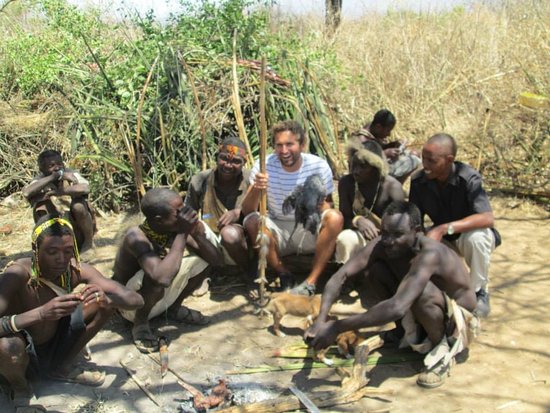
Day 7: Lake Eyasi Cultural Tour — Hadzabe Hunter-Gatherers & Datoga Blacksmiths
Day 7 offers one of Tanzania’s most distinctive and genuinely rare tourism experiences — an immersive cultural morning with the Hadzabe (Hadza), one of the world’s last remaining hunter-gatherer peoples and Tanzania’s oldest known indigenous group, living in the forested hills surrounding Lake Eyasi in much the same way their ancestors did thousands of years ago.
Lake Eyasi is the largest water body in the Arusha region — a soda lake sitting at the southern edge of the Serengeti ecosystem and directly southwest of the Ngorongoro Conservation Area.
Surprisingly larger than Lake Manyara, Lake Eyasi supports vast colonies of lesser and greater flamingo alongside numerous other waterbird species, and its surrounding forest and scrubland habitat is the ecological foundation for the Hadzabe’s traditional lifestyle.
The Hadzabe morning encounter begins before dawn, when your guide takes you to join a Hadza hunting party heading out with traditional bows and arrows — hunting small game and gathering wild berries, honey, and roots using techniques passed through generations without modification.
The Hadzabe speak a distinctive click language (Hadzane) unrelated to any other language family on earth, live in small semi-nomadic groups of 20–30 people, and maintain their extraordinary cultural independence despite enormous pressures from neighbouring agricultural tribes and the modern economy.
Spending a morning in their company is a privilege of the deepest kind — an encounter with a way of human life that predates agriculture itself.
The afternoon visit to the Datoga community — a Nilotic pastoralist tribe living adjacent to the Hadzabe — provides a striking cultural contrast. The Datoga are skilled metalworkers and blacksmiths whose traditional ironworking techniques produce the arrowheads, knives, and bracelets traded throughout the region.
Watching a Datoga blacksmith work molten metal into precision arrowheads using bellows and anvils built from materials entirely sourced from the surrounding environment is a demonstration of traditional technological sophistication that commands genuine respect.
Accommodation Options: – Budget: Eyasi Safari Lodge, Kisima Ngeda Tented Camp
Meals: Breakfast, Lunch, Dinner
Day 8: Lake Manyara National Park Half-Day Game Drive — Departure
The final morning of your 8-day Tanzania Northern Circuit safari is devoted to a half-day game drive in Lake Manyara National Park — a compact but extraordinarily productive park that consistently surprises visitors who arrive with lower expectations than Serengeti or Ngorongoro.
Lake Manyara National Park covers 325 square kilometres of rift valley floor, with the permanent alkaline Lake Manyara occupying approximately two-thirds of the park area and the remaining third consisting of dense groundwater forest, open floodplain, and acacia woodland.
This combination of habitats in a small area creates remarkable wildlife density: tree-climbing lions rest in the branches of fever trees along the lakeshore — a behaviour observed in very few lion populations outside of Uganda’s Ishasha Sector; enormous flocks of lesser flamingo turn the lake pink on windless mornings; and the park’s forest zone shelters blue monkeys, olive baboons, and African bush elephants at densities that make sightings almost certain.
After the morning game drive, the route continues north to Arusha Town for a farewell lunch before the transfer to Kilimanjaro International Airport for your scheduled flight home — completing one of East Africa’s most comprehensively satisfying budget safari itineraries.
Meals: Breakfast, Lunch
End of the 8 days Tanzania Budget Safari

What Is Included in the 8 Days Tanzania Budget Safari Package
- 7 nights’ accommodationin carefully selected budget safari lodges and tented camps — full board throughout
- Transportation by comfortable 4×4 safari vehiclewith game-viewing roof hatch throughout all eight days
- Professional English-speaking driver-guidewith specialist Northern Circuit knowledge
- All game drive feesfor Tarangire, Serengeti, Ngorongoro, Lake Eyasi, and Lake Manyara
- All national park and conservation area entry fees
- Olduvai Gorge museum entry fee
- Lake Eyasi Hadzabe and Datoga cultural programme fees
- Serengeti walking safari guide and ranger fees
- Bottled waterduring all game drives and transfers
- Hotel pick-up and drop-offat Arusha
- Driver allowances and fuel charges
- All applicable Tanzanian government taxes and levies
What Is Not Included
- International flights to and from Kilimanjaro International Airport
- Tanzania visa fees — currently USD $50 for most nationalities (e-visa available in advance at evisa.go.tz)
- Medical and travel insurance — comprehensive cover including medical evacuation is strongly recommended
- Accommodation in Arusha on the eve of departure and final night (available on request)
- Optional activities not specified in the itinerary — including Serengeti hot air balloon safari (available at significant additional cost and highly recommended)
- Personal expenses: laundry, telephone, tips, beverages, shopping, and snacks
- Tips for guides, camp staff, and lodge teams (USD $10–$20 per day per guide is standard and genuinely appreciated)
Best Time for a Tanzania Northern Circuit Budget Safari
Tanzania’s Northern Circuit can be visited year-round, but different seasons deliver different experiences and the timing of your visit dramatically affects what you see.
The dry season from June to October is generally considered the best time for a Tanzania wildlife safari on the Northern Circuit. During this period, vegetation is shorter and less dense, animals concentrate around permanent water sources, and game drives produce more reliable and close-up wildlife sightings.
The Great Migration river crossings at the Mara River occur most dramatically between July and October, making this the peak season for wildebeest crossing photography. The dry season is also the most comfortable physically — lower humidity, cooler temperatures in the highlands, and minimal rainfall.
The wet season from November to May brings lush green landscapes and is exceptional for birdwatching, as both resident and migratory bird species are at peak activity and plumage. The Serengeti calving season in January–February — when up to half a million wildebeest calves are born within a few weeks — is one of the most extraordinary wildlife events in Africa, with cheetahs, lions, hyenas, and jackals hunting intensively among the newborn calves. The wet season also offers significantly reduced tourist numbers and lower accommodation prices — ideal conditions for a budget Tanzania safari where value is the primary consideration.
Ngorongoro Crater is excellent year-round, and Lake Manyara and Tarangire are both particularly productive during the dry season when elephant concentrations at Tarangire are at their dramatic peak.
Tanzania Safari Game Drive Rules and Guidelines
Tanzania National Parks (TANAPA) and the Ngorongoro Conservation Area Authority (NCAA) enforce rules that protect both wildlife and visitors. Your guide is responsible for compliance — but understanding these rules helps you get the most from every game drive.
Stay on designated tracks and roads at all times — off-road driving is prohibited in all Tanzanian national parks and causes serious ecological damage to the savannah crust. Keep voices low and avoid shouting when animals are close — noise disturbs natural behaviour and reduces your sighting quality.
Do not feed any wildlife under any circumstances — habituation to human food causes behavioural changes that ultimately threaten the animals involved. Do not exit the vehicle unless your guide has confirmed it is safe to do so — Serengeti lions, Ngorongoro hyenas, and Cape buffalo are genuine dangers to people on foot in uncontrolled situations. Do not litter — carry all waste back to your camp. Respect all speed limits within park boundaries. Follow your guide and ranger instructions without question or delay.
Tanzania Northern Circuit Safari Packing List
Pack for warmth as well as heat — Ngorongoro crater rim sits above 2,300 metres elevation and mornings are genuinely cold. A fleece or warm mid-layer is essential for Ngorongoro game drives and the early morning Serengeti starts.
Neutral-coloured lightweight clothing (khaki, olive, tan) works across all habitats and is preferable to white or bright colours that disturb wildlife.
Comfortable closed walking shoes are needed for the Lake Eyasi morning and Serengeti walking safari. A wide-brimmed hat and high-SPF sunscreen protect during open-vehicle game drives at Serengeti and Ngorongoro. Pack quality binoculars (8×42 recommended) — essential for the flat Serengeti distances where animals are often far from the track.
A camera with a telephoto lens (400mm minimum for serious photography) captures wildlife at game-drive distances; bring spare batteries and multiple memory cards.
DEET-based insect repellent is essential, particularly at camp in the evenings. A reusable water bottle supplements the bottled water provided.
Book Your 8 Days Tanzania Budget Safari with Hail Tours Uganda
Hail Tours Uganda designs and operates affordable Tanzania safari packages for individuals, couples, families, and small groups who want to experience the very best of Tanzania’s Northern Circuit without the premium lodge price tag.
Our professional guides are Northern Circuit specialists with deep knowledge of Serengeti’s seasonal wildlife patterns, Ngorongoro’s crater ecology, and Tarangire’s elephant movements — expertise that makes the difference between a competent game drive and an extraordinary one.
Contact Hail Tours Uganda to check availability, confirm your preferred travel dates, and receive a personalised quotation for the 8-day Tanzania budget safari. Our Uganda Safari Itinerary Price Guide provides comparative pricing across all our East Africa packages.
Related Tours You May Find Useful
- 5 Days Tanzania Wildlife Tour — Northern Circuit
- 5 Days Serengeti and Ngorongoro Safari
- 4 Days Serengeti National Park Safari
- 3 Days Ngorongoro Crater Wildlife Safari
- 7 Days Tanzania Wildlife Safari
- 7 Days Luxury Tanzania Safari
- 7 Days Selous, Mikumi and Ruaha Safari
- 8 Days Tanzania Safari — Full Northern Circuit
- 9 Days Tanzania Wildlife Safari
- 10 Days Best of Tanzania Safari
- 14 Days Tanzania Safari and Zanzibar Beach
- 6 Days Kilimanjaro and Gorilla Safari
- 11 Days Kenya and Tanzania Safari
- 4 Days Masai Mara Safari — Kenya Tanzania Circuit
- 5 Days Masai Mara and Lake Naivasha
- 6 Days Masai Mara, Lake Nakuru and Amboseli Safari
- 7 Days Best of Kenya Safari
- 8 Days Kenya Big Five Safari
- 7 Days Gorilla Trek and Wildebeest Migration
- 8 Days Rwanda Gorilla Trekking
- 7 Days Uganda Wildlife Safari
- 18 Days African Safari — Uganda, Kenya and Tanzania
- 10 Days Africa Safari — Uganda and Kenya
- Tanzania Safaris — All Packages
- Kenya Safaris — All Packages
- Uganda Safari Itinerary Price Guide
- About Hail Tours Uganda