
Gorilla Species in Africa: 4 Types, Facts, Habitats & Photos 2026 Guide
Gorilla species in Africa are among the most fascinating and critically important primates on earth. There are two main gorilla species in Africa — the Eastern gorilla (Gorilla beringei) and the Western gorilla (Gorilla gorilla) — each divided into two subspecies, making four gorilla subspecies in total.
Understanding the differences between these magnificent great apes, where they live, how many remain in the wild, and why they matter to Africa’s ecosystems is essential for anyone interested in wildlife conservation, gorilla trekking, or African natural history.
The four gorilla subspecies are:
- Western Lowland Gorilla (Gorilla gorilla gorilla)
- Cross River Gorilla (Gorilla gorilla diehli)
- Mountain Gorilla (Gorilla beringei beringei)
- Eastern Lowland Gorilla (Gorilla beringei graueri)
As of 2025/2026, the total global gorilla population is estimated at approximately 317,000 individuals across both species and all four subspecies. Mountain gorillas — the rarest of them all — have recovered to 1,063–1,080 individuals, a remarkable conservation success story that represents one of the greatest wildlife turnarounds in modern history.
Why Gorillas Are Critical to Africa’s Biodiversity
Gorillas are keystone species in Africa’s tropical forests. As large frugivores and herbivores, they disperse seeds across vast distances, helping to regenerate forests and maintain the biodiversity of Central and East Africa’s ecosystems. Losing any gorilla species or subspecies from Africa’s forests would trigger cascading ecological consequences that would affect thousands of other plant and animal species.
All four gorilla subspecies are endangered or critically endangered, making their study, protection, and the support of gorilla tourism in countries like Uganda, Rwanda, and the DRC among the most urgent conservation priorities on the continent.

The Four Gorilla Subspecies in Africa: A Complete Guide
1. Western Lowland Gorilla — The Most Numerous Gorilla Species
The Western Lowland Gorilla (Gorilla gorilla gorilla) is the most numerous of all gorilla subspecies, with an estimated 300,000+ individuals remaining in the wild — though their population has declined by approximately 60% over the past 25 years, primarily due to habitat destruction and the Ebola virus.
Where to Find Western Lowland Gorillas in Africa
Western Lowland Gorillas occupy the dense tropical and subtropical forests of Central and West Africa. Their range spans Angola, Cameroon, the Central African Republic, Equatorial Guinea, Gabon, the Democratic Republic of Congo, and the Republic of the Congo. This makes them the most geographically widespread gorilla subspecies in Africa.
Western Lowland Gorillas are the species most commonly seen in zoos worldwide and are the gorillas most frequently encountered by researchers — though the remoteness of many of their habitats in Central African forests means significant portions of the population remain poorly documented.
Physical Characteristics of Western Lowland Gorillas
The Western Lowland Gorilla is slightly smaller than the Eastern species but still an imposing animal. A male silverback Western Lowland Gorilla stands approximately 5.6–5.9 feet (1.7–1.8 metres) tall when upright and weighs between 300–500 pounds (136–227 kilograms). Females are considerably smaller, weighing 68–113 kilograms with a height of 1.2–1.5 metres.
Compared to Eastern gorillas, Western Lowland Gorillas are distinguished by:
- A distinctive reddish-brown or greyish coat (contrasting with the darker fur of Eastern subspecies)
- A smaller, hairless black face with pronounced brow ridges
- A broad, flat nose with slightly protruding lips
- Slightly smaller overall body frame
They are omnivorous with a strong preference for fruit — making them more frugivorous than mountain gorillas — supplementing their diet with leaves, vegetation, stems, bark, and occasionally insects like ants and termites.
Conservation Status: Western Lowland Gorilla
Western Lowland Gorillas are classified as Critically Endangered by the IUCN. The 2003 Ebola outbreak alone killed approximately 30% of the population in some regions.
Today, the greatest threats to Western Lowland Gorilla survival are deforestation, bushmeat poaching, illegal wildlife trafficking, and repeated Ebola outbreaks across Central Africa.

2. Cross River Gorilla — Africa’s Most Endangered Gorilla Subspecies
The Cross River Gorilla (Gorilla gorilla diehli) is the rarest gorilla subspecies on earth and one of the most endangered primates in the world. With only approximately 300 individuals remaining — spread across nine isolated forest patches — the Cross River Gorilla is in genuine danger of extinction without sustained international intervention.
The IUCN first formally recognised the Cross River Gorilla as a distinct subspecies in 2006, listing it among the world’s most endangered species. Despite decades of conservation effort, its population has remained perilously low due to the severe fragmentation of its habitat.
Where Do Cross River Gorillas Live?
Cross River Gorillas inhabit a small, rugged region straddling the border between Nigeria and Cameroon, in the Cross River region after which they are named.
Their nine isolated population fragments are separated by human-modified landscapes — farmland, roads, and settlements — that prevent natural movement and genetic exchange between groups, accelerating the species’ vulnerability.
Behaviour and Physical Characteristics of Cross River Gorillas
Cross River Gorillas are similar in size and colouration to Western Lowland Gorillas, but their centuries of isolation have produced subtle morphological differences including slightly different skull and tooth proportions. Their prolonged exposure to human pressure has made them exceptionally wary and often aggressive toward human presence — they have been observed throwing sticks and grass at researchers and trackers, making them one of the most difficult primate species in Africa to study.
Cross River Gorillas have never been opened for gorilla tourism and are not held in captivity anywhere in the world — making them one of the very few gorilla subspecies that most people will never see in person.
Conservation Efforts for Cross River Gorillas
Conservation of the Cross River Gorilla involves a coalition of the International Wildlife Conservation (WCS), WWF, and the governments of Nigeria and Cameroon. Key interventions include aggressive anti-poaching programmes, legal enforcement against habitat encroachment, and community sensitisation initiatives in villages adjacent to gorilla territory. WWF has supported active reforestation programmes in agricultural buffer zones to reconnect isolated gorilla populations and allow genetic exchange.

3. Eastern Lowland Gorilla (Grauer’s Gorilla) — The World’s Largest Gorilla
The Eastern Lowland Gorilla (Gorilla beringei graueri), also known as Grauer’s Gorilla, holds the distinction of being the largest gorilla subspecies — and the largest primate species — on earth.
Despite this imposing stature, Grauer’s Gorilla is Critically Endangered with an estimated 3,800–6,800 individuals remaining in the wild according to updated 2021 assessments.
Where to Find Eastern Lowland Gorillas in Africa
Grauer’s Gorilla is endemic to the Democratic Republic of Congo, primarily within the Albertine Rift forests of eastern DRC. Key habitats include:
- Kahuzi-Biega National Park (South Kivu)
- Maiko National Park (Maniema/North Kivu border)
- Itombwe Massif (South Kivu)
- Odzala-Kokoua National Park (Republic of Congo)
Their historical range once covered approximately 81,000 km² of forest. Ongoing conflict, artisanal mining incursions, and agricultural expansion have reduced their effective habitat area to approximately 5,600 km² — a catastrophic 93% reduction.
Physical Characteristics of Grauer’s Gorilla
The Eastern Lowland Gorilla is distinguished from other subspecies by:
- A particularly large, muscular body — males can exceed 200 kilograms
- Shorter fur compared to mountain gorillas
- Larger hands and a shorter, broader muzzle
- A stockier overall build reflecting adaptation to lowland forest conditions
Conservation Challenges for Eastern Lowland Gorillas
The primary drivers of Grauer’s Gorilla decline are the armed conflicts in eastern DRC, artisanal mining operations that cut deep into protected forests, bushmeat poaching to feed mining camp populations, and charcoal production that destroys forest cover.
Several conservation organisations — including the Dian Fossey Gorilla Fund, WCS, and WWF — are working to protect remaining populations, establish extended protected area networks, and reduce the impact of armed groups on Kahuzi-Biega’s wildlife.
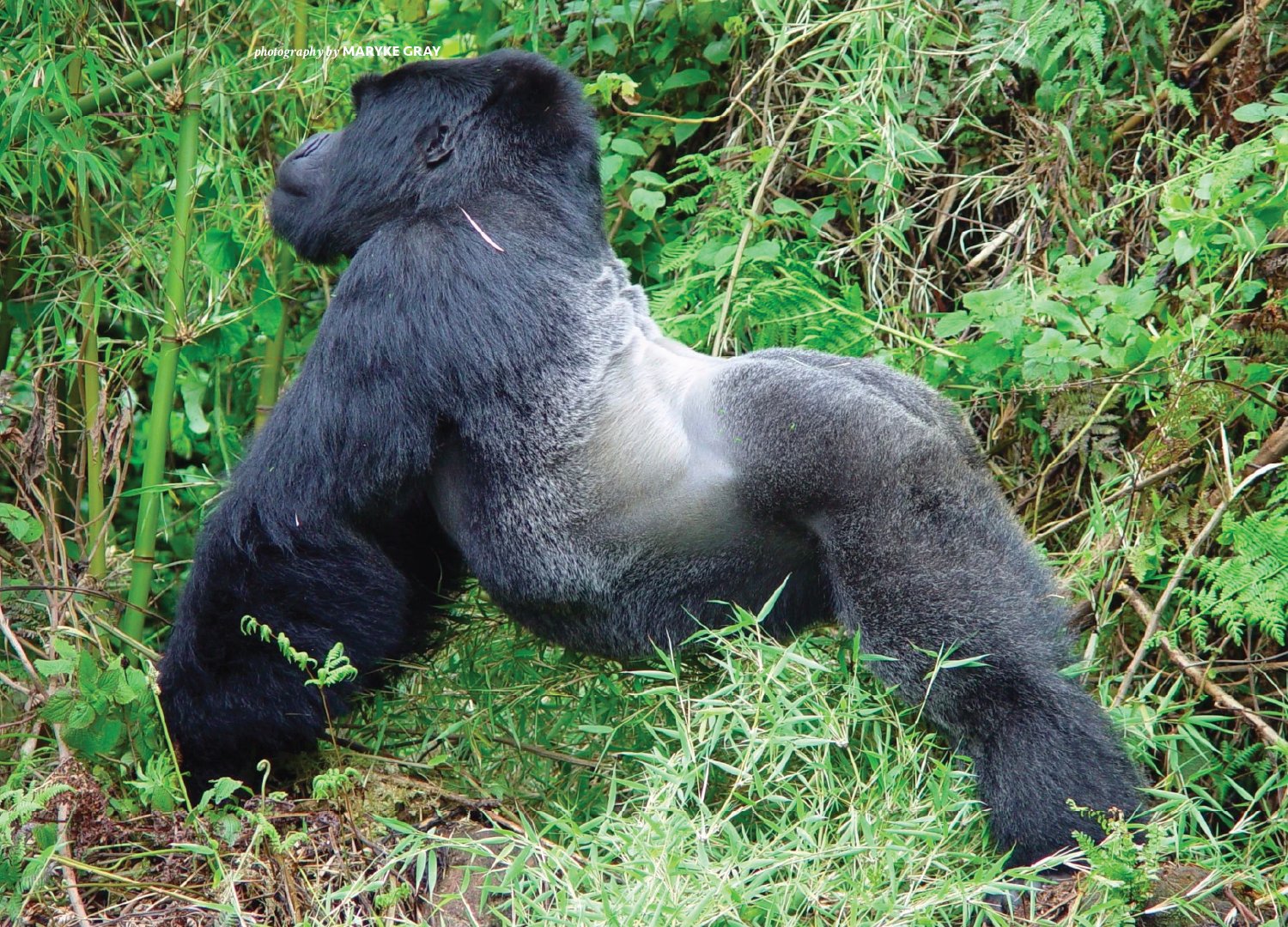
4. Mountain Gorilla — Africa’s Greatest Conservation Success Story
The Mountain Gorilla (Gorilla beringei beringei) is simultaneously the most famous gorilla subspecies, the second rarest, and the subject of the most celebrated wildlife conservation success in modern African history.
As of 2025/2026, the global mountain gorilla population has risen to approximately 1,063–1,080 individuals — up from fewer than 400 in the 1980s and just 250 in the 1970s when extinction seemed almost certain.
This remarkable recovery is the direct result of decades of sustained conservation investment, gorilla tourism revenue, community engagement, and veterinary interventions by organisations including the Dian Fossey Gorilla Fund, IGCP, WWF, WCS, and the national park authorities of Uganda, Rwanda, and DRC.
A new 2025 Bwindi-Sarambwe census — the most comprehensive population survey in years — was launched in May 2025 by the International Gorilla Conservation Programme (IGCP) and the Greater Virunga Transboundary Collaboration, with full results anticipated in 2026 and expected to refine estimates upward.
Where Do Mountain Gorillas Live? Habitat and Distribution
Mountain Gorillas are found exclusively in two ecosystems — both spanning the border zones of Uganda, Rwanda, and the Democratic Republic of Congo:
1. The Virunga Massif — a chain of eight volcanoes spanning Uganda, Rwanda, and DRC, sheltering approximately 604+ mountain gorillas across three national parks:
- Volcanoes National Park, Rwanda (Parc National des Volcans)
- Virunga National Park, DRC
- Mgahinga Gorilla National Park, Uganda
2. Bwindi Impenetrable National Park, Uganda — the single most important site for mountain gorilla conservation, hosting approximately 459+ individuals (from the 2018 census, with modest increases since) across multiple gorilla families. Bwindi is also a UNESCO World Heritage Site.
Mountain gorillas inhabit altitudes of 2,400–4,000 metres (8,000–13,000 feet) — among the highest elevations of any great ape habitat. Their terrain is characterised by dense, mist-covered tropical montane forests, steep volcanic slopes, bamboo zones, and afro-alpine heath.
Physical Characteristics of Mountain Gorillas
Mountain gorillas are the most physically impressive of all gorilla subspecies, distinguished by:
- Thick, dense, very dark fur — an adaptation to cold high-altitude temperatures; significantly longer and denser than the fur of any other gorilla subspecies
- A mature silverback male weighing 300–490 pounds (135–220 kg), standing 5.5–6 feet when upright
- Broad chest, massive arms, and powerful legs built for navigating steep, rugged volcanic terrain
- Females considerably smaller, typically 150–215 pounds (70–98 kg) and 4–5 feet tall when upright
- Family groups of approximately 5–30 members, always led by at least one dominant silverback
Mountain Gorilla Diet
Mountain gorillas are primarily herbivorous, feeding on leaves, shoots, stems, bark, bamboo, and occasional insects. Unlike Western Lowland Gorillas, which seek out fruit heavily, mountain gorillas rely more on fibrous plant material — a dietary adaptation to their high-altitude habitat where fruit is less abundant.
Why Mountain Gorilla Conservation Has Succeeded
The recovery of mountain gorillas from near-extinction to over 1,000 individuals represents one of the most important conservation achievements of the 21st century. The key drivers of success have been:
- Gorilla trekking tourism in Uganda, Rwanda, and DRC generating direct revenue for protected areas and local communities — demonstrating that living gorillas are economically more valuable than any alternative use of their habitat
- Anti-poaching patrols reducing illegal snare setting, bushmeat poaching, and habitat encroachment
- Veterinary interventions treating injured gorillas and managing disease transmission from humans
- Community engagement connecting village livelihoods to gorilla conservation outcomes through revenue sharing
- Transboundary cooperation between Uganda, Rwanda, and DRC through the Greater Virunga Transboundary Collaboration
Eastern Gorillas vs. Western Gorillas: Key Differences and Similarities
Similarities Between Eastern and Western Gorillas
All four gorilla subspecies share fundamental biological characteristics: a knuckle-walking locomotion, strong family bonds within troops led by dominant silverback males, nest-building behaviour (constructing a fresh ground or tree nest every night), complex social communication through vocalisations, chest-beating, and facial expressions, and a largely herbivorous diet adjusted to seasonal availability.
Differences Between Eastern and Western Gorillas
| Feature | Eastern Gorillas | Western Gorillas |
|---|---|---|
| Size | Generally larger | Slightly smaller |
| Fur colour | Dark black, thick dense coat | Brownish-grey, shorter fur |
| Facial features | Broader muzzle, narrower face | Wider face, more pronounced brow ridge |
| Habitat | High-altitude montane and lowland forests of DRC, Rwanda, Uganda | Lowland tropical forests of West and Central Africa |
| Countries | Uganda, Rwanda, DRC | Cameroon, Gabon, CAR, Republic of Congo, Angola, Nigeria |
| Diet emphasis | Leaves, stems, bamboo | More frugivorous; fruit-heavy diet |
| Population | ~5,000 combined | ~317,000 combined |
Gorilla Subspecies: Habitat Comparison at a Glance
Mountain Gorillas (Eastern): Dense high-altitude montane rainforest at 2,400–4,000m in the Virunga Massif and Bwindi. Thick long fur adapted to cold. Found only in Uganda, Rwanda, and DRC.
Eastern Lowland Gorillas (Eastern): Lowland tropical and montane forests of eastern DRC. Largest body size of all gorilla subspecies. Critically endangered due to conflict and mining.
Western Lowland Gorillas (Western): Dense swampy tropical forests at low altitudes across seven countries in West and Central Africa. Most numerous subspecies. Strongly frugivorous.
Cross River Gorillas (Western): Rugged hilly forests along the Nigeria-Cameroon border. Critically endangered with only ~300 individuals. Never available for tourism.
Gorilla Trekking: How to See Gorillas in the Wild
Mountain gorillas are one of the few gorilla subspecies available for regulated wildlife tourism. Gorilla trekking — guided excursions into mountain gorilla habitat — is available in three countries:
- Uganda: Bwindi Impenetrable National Park and Mgahinga Gorilla National Park. Uganda offers the largest number of gorilla families open for trekking, with permits available through the Uganda Wildlife Authority (UWA).
- Rwanda: Volcanoes National Park (Parc National des Volcans). Rwanda’s gorilla trekking is premium-priced and immensely popular for its accessibility and landscape.
- Democratic Republic of Congo: Virunga National Park. Lower-priced permits in a more adventurous, remote setting.
Gorilla trekking tourism generates critical revenue that directly funds conservation patrols, ranger salaries, and community benefit programmes — making it one of the most effective conservation finance mechanisms in the world.
FAQs About Gorilla Species in Africa
1. How many gorilla species are there in Africa?
There are two main gorilla species in Africa: the Western Gorilla (Gorilla gorilla) and the Eastern Gorilla (Gorilla beringei). Each species has two subspecies, making a total of four gorilla subspecies:
- Western Lowland Gorilla (Gorilla gorilla gorilla)
- Cross River Gorilla (Gorilla gorilla diehli)
- Mountain Gorilla (Gorilla beringei beringei)
- Eastern Lowland Gorilla (Gorilla beringei graueri)
2. Where can I find gorillas in Africa?
Gorillas are found in the tropical forests of Central and East Africa. Western gorillas inhabit Cameroon, Gabon, the Republic of Congo, the Central African Republic, Angola, Equatorial Guinea, and DRC. Eastern gorillas are found in Uganda, Rwanda, and the Democratic Republic of Congo. The only places where gorilla trekking is available for tourists are Uganda, Rwanda, and the DRC.
3. What is the difference between mountain gorillas and lowland gorillas?
Mountain gorillas live in high-altitude forests at 2,400–4,000 metres and have thicker, darker fur to survive cold temperatures. They are only found in Bwindi Impenetrable Forest and the Virunga Mountains. Lowland gorillas inhabit dense tropical lowland forests and have shorter, lighter fur. They are more widespread, especially in Central and West Africa, and tend to have more fruit-heavy diets.
4. How many mountain gorillas are left in the world in 2026?
As of 2025/2026, there are approximately 1,063–1,080 mountain gorillas left in the wild — the highest number recorded since comprehensive conservation monitoring began. They are split between the Virunga Massif (~604+ individuals) and Bwindi Impenetrable National Park (~459+ individuals).
A new Bwindi-Sarambwe census launched in May 2025 is expected to refine these estimates when results are published in 2026.
5. What do gorillas eat?
Gorillas are mainly herbivores, consuming leaves, shoots, stems, fruits, bark, and bamboo. Some also eat small insects like ants and termites. Their diet varies by subspecies and habitat — mountain gorillas eat more leaves and stems; western lowland gorillas consume more fruit.
6. Are gorillas dangerous to humans?
Gorillas are generally peaceful and shy unless threatened. They live in stable troops led by a dominant silverback. When provoked or surprised, a gorilla may display aggression through chest beating, grunting, or charging — but actual attacks on humans are extremely rare. For gorilla trekking, habituated family groups are accustomed to brief human presence and behave naturally.
7. How long do gorillas live?
In the wild, gorillas typically live 35–40 years. In captivity, with controlled nutrition and veterinary care, gorillas have lived 50 years or more.
8. How do gorillas communicate?
Gorillas use a rich combination of vocalisations, body postures, and facial expressions to communicate. They grunt, bark, hoot, scream, and beat their chests. Chest-beating by silverbacks communicates dominance, signals the group’s location, and serves as a warning to rival males.
9. Can you go gorilla trekking to see gorillas in the wild?
Yes — gorilla trekking is one of Africa’s most extraordinary wildlife experiences. Treks take visitors into mountain gorilla habitat in Uganda, Rwanda, and the DRC for one-hour encounters with habituated gorilla families. Permits must be booked in advance through national park authorities.
10. Why are gorillas endangered?
All four gorilla subspecies are endangered or critically endangered. Primary threats include habitat destruction from logging, agriculture, and artisanal mining; poaching for bushmeat and illegal wildlife trade; disease including Ebola virus and respiratory infections transmitted from humans; and armed conflict in DRC that limits conservation presence in key areas.
Despite these threats, sustained conservation investment — particularly in mountain gorilla habitat — demonstrates that gorilla populations can recover when protection is prioritised.
Conclusion: Protecting Africa’s Gorilla Species for Future Generations
The story of gorilla species in Africa in 2026 is one of both genuine hope and persistent danger. Mountain gorillas have defied extinction, growing from 250 individuals in the 1970s to over 1,000 today — proving that coordinated conservation works.
Western Lowland Gorillas, despite their relative abundance, continue to decline at alarming rates. Grauer’s Gorilla and the Cross River Gorilla remain in critical condition, with tiny populations and vast ongoing threats.
Supporting gorilla conservation in Africa — whether through responsible gorilla trekking tourism, donations to organisations like the Dian Fossey Gorilla Fund, WWF, or WCS, or advocacy for habitat protection policies — directly contributes to the survival of some of the world’s most intelligent and emotionally complex animals.
Africa’s forests are richer, more diverse, and more alive because gorillas are in them. The challenge of the coming decade is ensuring they remain there.