Fun Facts About a Sloth: 25 Surprising Sloth Facts You’ll Love
Fun Facts About a Sloth: Sloths are among the most charming and unusual animals on Earth. These slow-moving mammals, often seen hanging upside down from tree branches in tropical rainforests, captivate people with their laid-back lifestyle and perpetual “smiling” faces.
If you’re searching for fun facts about a sloth, interesting facts about sloths, or sloth behavior facts, you’re in the right place. Far from being lazy, sloths have evolved remarkable adaptations that make their slow pace a brilliant survival strategy.
25 Fun Facts About a Sloth
Here’s a numbered list of engaging sloth facts that highlight their unique biology and quirky habits:
- Sloths sleep up to 15–20 hours a day. They conserve energy by resting extensively, often curled up in the canopy.
- They are the slowest mammals on Earth. On the ground, they move at about 0.15–0.3 mph, covering less than 40 yards per day on average.
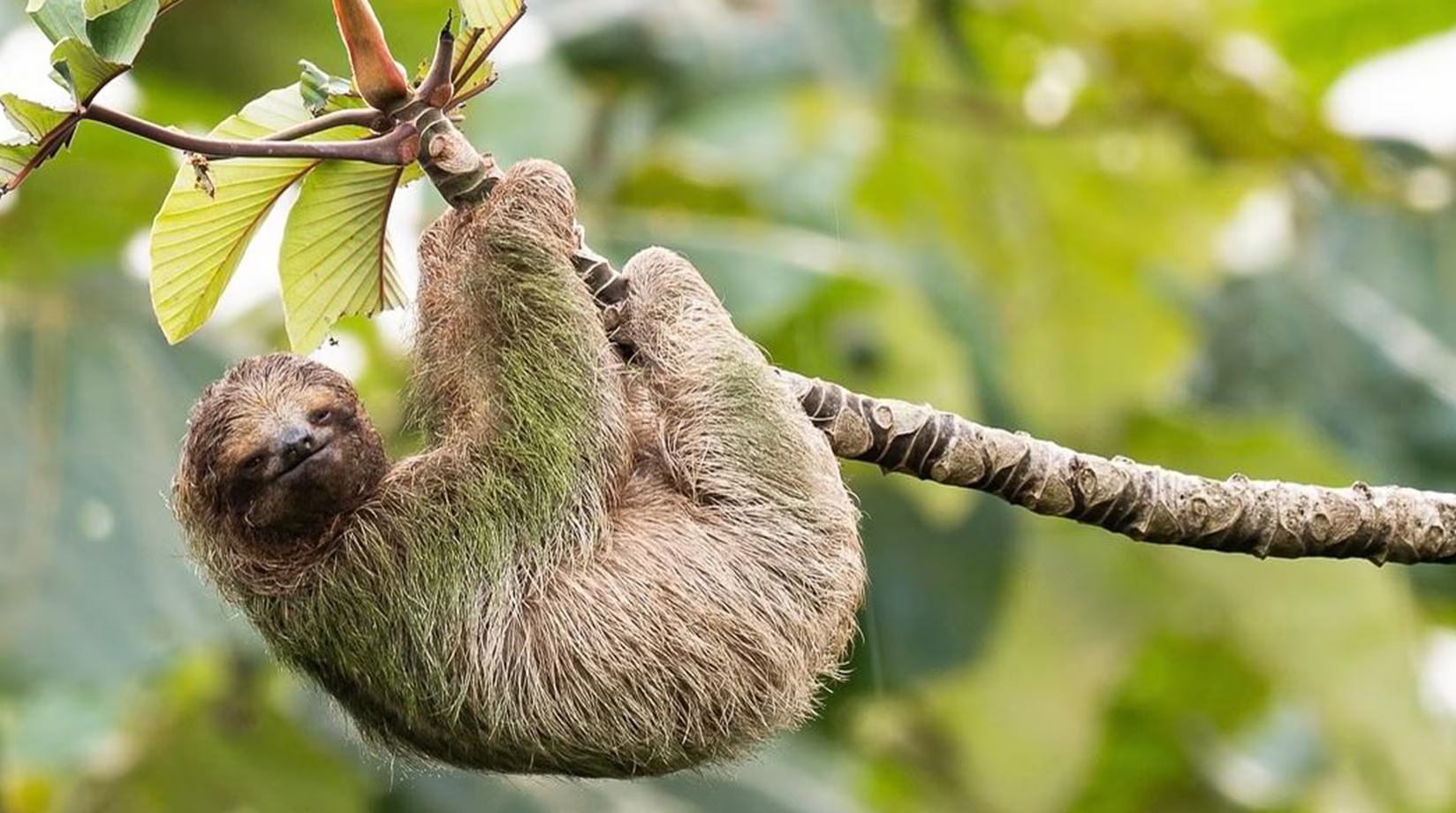
- Algae grows on their fur, providing natural camouflage. The greenish tint helps them blend perfectly with leaves, hiding from predators like eagles and jaguars.
- Sloths can rotate their heads up to 270 degrees. Three-toed sloths have extra neck vertebrae, allowing an almost owl-like range of vision without moving their body.
- They are surprisingly good swimmers. Sloths swim three times faster in water than they move on land and often use a backstroke style.
- Sloths descend from trees only about once a week to poop. This risky trip to the forest floor is one of their few regular ground visits.
- Their digestion can take up to a month. A single meal of leaves may linger in their stomach for weeks due to their extremely slow metabolism.
- Ancient giant sloths existed the size of elephants. Extinct ground sloths like Megatherium were massive compared to today’s tree-dwelling species.
- Sloths are three times stronger than humans relative to their size. They can hang from branches or pull themselves up with one arm effortlessly.
- They poop up to a third of their body weight in one go. When they finally relieve themselves, it’s a massive event!
- Sloths fall from trees about once a week. Poor eyesight contributes to occasional slips, but they are surprisingly resilient and often survive falls from great heights.
- Their fur hosts an entire mini-ecosystem. Moths, beetles, fungi, and algae live in their shaggy coats, creating a symbiotic relationship.
- Sloths have the lowest body temperature of any mammal. It can drop as low as 20–30°C (68–86°F), helping them save energy.
- They spend most of their lives hanging upside down. Eating, sleeping, mating, and even giving birth often happen while suspended.
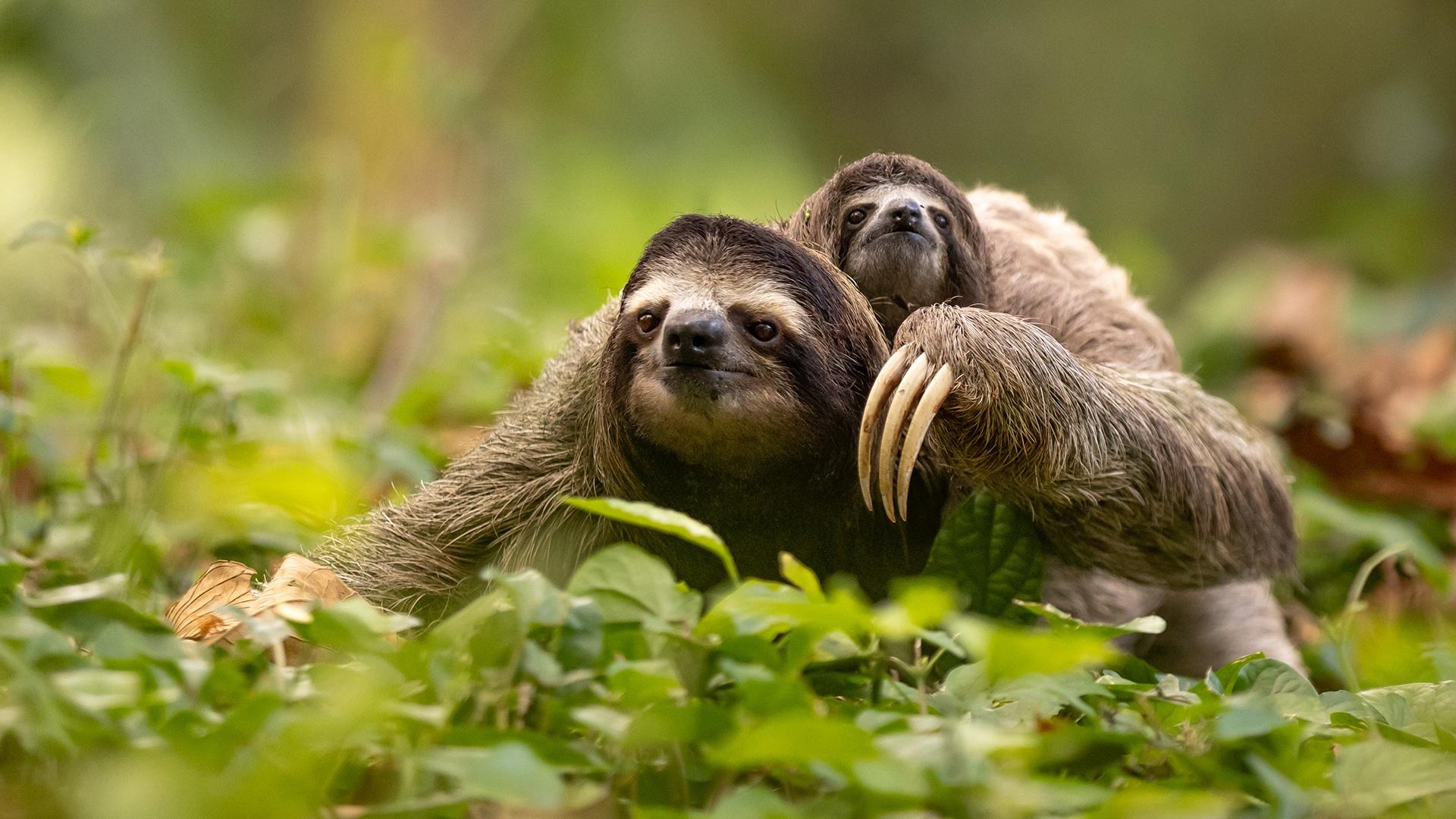
- Baby sloths are born with eyes open and teeth ready. They cling tightly to their mother’s fur from the moment of birth.
- Sloths are mostly solitary but surprisingly strong. Despite their slow appearance, they have powerful grips and can defend themselves with sharp claws if threatened.
- Two-toed sloths are slightly larger and more active than three-toed ones. They also have a more varied diet that sometimes includes insects or small lizards.
- Three-toed sloths often look like they’re smiling due to dark facial markings that form a “mask.”
- Sloths have poor eyesight but a good sense of smell and touch. They rely more on these senses while navigating the canopy.
- Their tongues are covered in backward-facing spines. This helps them strip tough leaves efficiently.
- Sloths can survive falls from over 100 feet. Their lightweight build and strong grip often prevent serious injury.
- They are related to armadillos and anteaters. All belong to the superorder Xenarthra, sharing unique skeletal features.
- Sloths rarely fight over food. Their low-energy lifestyle means they don’t need to compete aggressively.
- Some sloths mistake their own arm for a branch and grab it, occasionally causing falls.
- Without ancient giant sloths, avocados might not exist today. Those massive creatures helped disperse large avocado seeds.
These fun facts about a sloth show that their slow lifestyle is a sophisticated adaptation, not laziness.
Types of Sloths
There are two main groups of sloths: two-toed and three-toed, though the naming can be confusing. All sloths have three toes (claws) on their hind limbs. The difference lies in their forelimbs: two-toed sloths have two claws on their hands, while three-toed sloths have three.
Two-toed sloths (genus Choloepus) are generally larger, with shaggier fur and a more omnivorous diet. They can rotate their heads about 90 degrees and tend to be slightly more active.
Three-toed sloths (genus Bradypus) have a distinctive facial mask, can turn their heads 270 degrees, and are stricter herbivores. They often appear more “smiling” and docile. Both types evolved tree-hanging lifestyles independently through convergent evolution.
Habitat and Where Sloths Live
Sloths are native to the tropical rainforests of Central and South America, from Nicaragua down to Brazil and Argentina. They live almost exclusively in the forest canopy, rarely descending to the ground.
This arboreal lifestyle keeps them safe from many ground predators while providing constant access to leaves. Deforestation poses a major threat, as sloths depend entirely on healthy, connected rainforest trees.
What Sloths Eat
Sloths are primarily folivores (leaf-eaters). They consume leaves, buds, tender shoots, and sometimes fruits or flowers from a limited number of tree species.
Two-toed sloths have a broader diet that may include insects or small vertebrates. Their slow metabolism allows them to survive on this low-calorie, tough-to-digest food. A sloth’s stomach is massive relative to its body and contains bacteria that help break down cellulose over weeks.
Why Sloths Are So Slow
The slowness of sloths is a brilliant survival strategy rooted in science. Their diet of leaves provides very little energy, so they have evolved one of the lowest metabolic rates among mammals—around 40–74% of what would be expected for their size.
They also have reduced muscle mass (about 30% less than similar-sized mammals) and variable body temperature that drops at night to save energy.
Moving slowly helps them avoid detection by visually hunting predators like harpy eagles and big cats. Their camouflage (aided by algae) completes the defense: stay still, blend in, and survive on minimal resources.
Sloth Behavior and Lifestyle
Sloths are largely solitary and spend 90% or more of their time in trees. They are mostly nocturnal or crepuscular but can be active during the day too. They move deliberately between branches using long, curved claws that act like hooks. Despite their reputation, they can be surprisingly fierce if cornered, biting, slashing, and shrieking.
Baby Sloths
Baby sloths (sometimes called “slowbies” by enthusiasts) are incredibly adorable and dependent. Born after a gestation of about 6 months, they cling to their mother’s belly or back immediately.
They nurse for several months while learning which leaves are safe by sampling from the mother’s mouth. Young sloths stay with mom for up to 2–4 years in some cases, learning the ropes of canopy life. The strong bond helps them survive in a challenging environment.
Threats and Conservation
Most sloth species are listed as Least Concern by the IUCN, but all face serious threats from deforestation, habitat fragmentation, climate change, and the illegal pet trade. The pygmy three-toed sloth is Critically Endangered, restricted to one small island off Panama. The maned three-toed sloth is Vulnerable. Conservation efforts focus on protecting rainforests and educating communities about the importance of sloths to ecosystem health.
Quick Facts Table
|
Feature |
Sloth |
|
Lifespan |
20–30 years (up to 43–49 in captivity) |
|
Habitat |
Tropical rainforests of Central & South America |
|
Diet |
Primarily leaves (folivore) |
|
Speed |
Extremely slow (~0.15–0.3 mph on ground) |
|
Weight |
3.5–9 kg (8–20 lbs) |
|
Length |
45–75 cm (18–30 inches) |
FAQ About Sloths
Why are sloths so slow?
Their low-calorie leaf diet and extremely slow metabolism force them to conserve every bit of energy. Slow movement also helps them stay camouflaged from predators.
Are sloths lazy or just energy-efficient?
They are highly energy-efficient, not lazy. Their entire physiology is optimized for a low-energy lifestyle in the treetops.
Can sloths swim?
Yes! They are excellent swimmers and can cross rivers using a backstroke when necessary.
How long do sloths live?
In the wild, typically 20–30 years, though some have reached over 40 years in captivity.
Do sloths ever come down from trees?
Yes, usually once a week to defecate. This is one of the most vulnerable times in their lives.
Conclusion
Sloths are evolutionary marvels perfectly adapted to their rainforest home. From algae-covered fur to month-long digestion, these interesting sloth facts reveal a creature that thrives by doing less.
While true sloths don’t live in Africa, Uganda offers world-class primate experiences that capture the same sense of wonder and tranquility. Hails Tours Uganda stands out among Uganda tour operators and gorilla trekking companies Uganda for its personalized service, experienced guides, and affordable yet high-quality Uganda safari booking options.
Whether you want a short chimpanzee trek, a multi-day gorilla safari, or a romantic rainforest adventure, our packages make it easy and memorable.
Ready to trade sloth curiosity for real African wildlife magic? Contact Hails Tours Uganda today to customize your Uganda wildlife safari or gorilla trekking Uganda package. Limited permits sell out fast — book early for the experience of a lifetime in Uganda’s enchanting forests.