
Gombe Chimpanzee War Explained: Territorial Battles, Killings,+ Jane Goodall’s Revelations
The Gombe chimpanzee war, also known as the chimpanzee war in Gombe or the Four-Year War, stands as one of the most profound discoveries in primatology.
It was a real, documented conflict between two rival communities of wild chimpanzees in Tanzania’s Gombe Stream National Park, observed between 1974 and 1978.
This violent territorial struggle revealed the darker, strategic side of chimpanzee behavior, including coordinated attacks, ambushes, and lethal aggression.
Jane Goodall’s long-term chimpanzee research at Gombe brought this event to light, forever changing how scientists and the public view our closest living relatives.
What began as a study of seemingly peaceful primates uncovered deep insights into chimpanzee territorial behavior, social dynamics, and evolutionary parallels with human conflict.
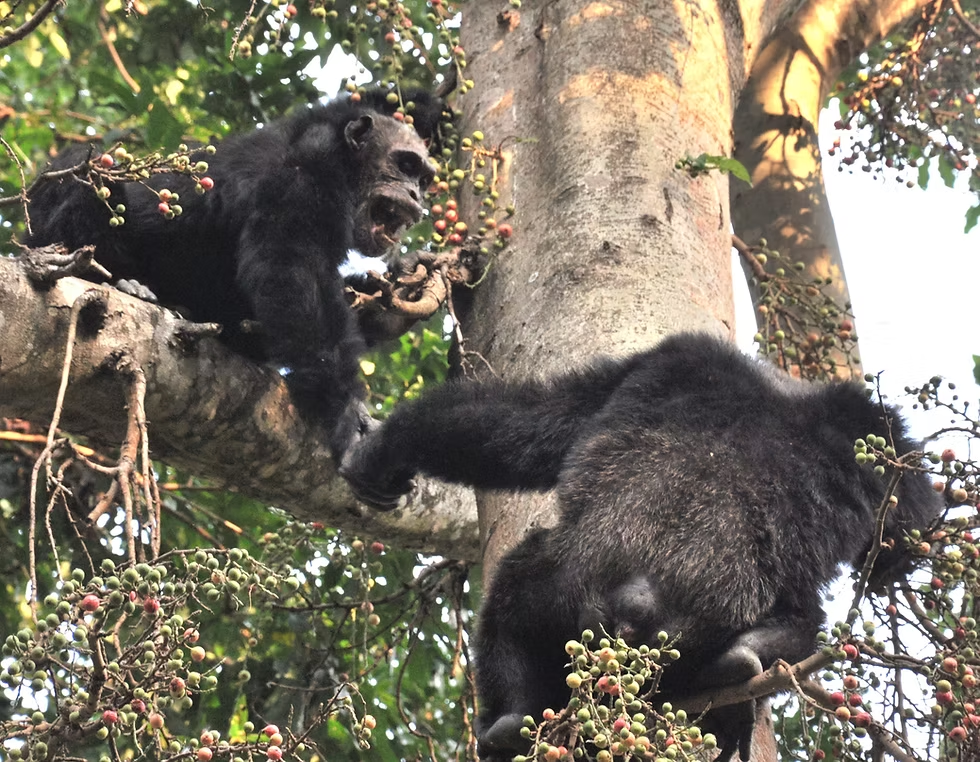
Background of Gombe Stream National Park
Gombe Stream National Park lies along the steep, forested hills of Tanzania’s western border, hugging the eastern shores of Lake Tanganyika in the Kigoma Region.
This small protected area—spanning about 35 square kilometers—features a mix of tropical rainforest, woodland, and grassland valleys carved by streams flowing into the lake.
The rugged terrain, with its dense vegetation and seasonal fruiting trees, provides ideal habitat for chimpanzees, supporting their arboreal and terrestrial lifestyles.
The park gained international fame when Jane Goodall arrived in July 1960 at the invitation of paleoanthropologist Louis Leakey. At just 26 years old and without formal scientific training, Goodall set up camp to study wild chimpanzees.
Her work transformed Gombe into the world’s longest-running study of a wild primate population. Initially called the Gombe Stream Chimpanzee Reserve, it became a national park in 1968.
Goodall’s pioneering observations here included tool use (stripping twigs to “fish” for termites), meat-eating, and complex social bonds—findings that challenged the idea of humans as the sole toolmakers and revealed chimpanzees’ intelligence and emotional depth.
Gombe’s isolation by boat and its rich biodiversity made it perfect for detailed, habituated observation of chimpanzee groups without heavy human interference at the time.
The Kasakela community, the main group Goodall followed, became iconic through her books like In the Shadow of Man and Through a Window.
What the Gombe Chimpanzee War Was
The Gombe chimpanzee war was a brutal, four-year conflict between two factions that had once formed a single community. By the early 1970s, the original Kasakela community began to splinter.
A subgroup moved south into the Kahama Valley area, forming the smaller Kahama community (sometimes spelled Kahoma). This division set the stage for escalating violence.
What followed was not random fighting but organized, lethal raids resembling territorial warfare. Males from the larger northern Kasakela group systematically targeted and eliminated males from the southern Kahama group.
The war, lasting from January 7, 1974, to June 5, 1978, resulted in the complete eradication of the Kahama males and the absorption or displacement of females and young.
Researchers documented at least 10-15 deaths or disappearances, with attacks involving beatings, biting, and even elements of cannibalism in some cases.
This event marked the first detailed scientific record of sustained intergroup “warfare” in wild chimpanzees, highlighting their capacity for planned coalition-based aggression.
Causes of the Gombe chimpanzee war
Several interconnected factors triggered the Gombe chimpanzee war. Social tensions built within the original Kasakela group after the death of a high-ranking male leader around 1971. Leadership disputes and shifting alliances created factions, with some males and their associates gravitating south.
Competition for territory played a central role. Chimpanzees are highly territorial, and splitting allowed access to new resources like fruit trees and nesting sites. Resource scarcity—exacerbated by seasonal food availability in the limited park area—likely intensified rivalry.
A possible shortage of fertile females in the original group may have heightened male competition, pushing the split and subsequent conflict.
Primatologists note that such fissions often stem from internal power struggles rather than external pressures alone. In Gombe’s case, the division reduced group cohesion, turning former allies into enemies as “us versus them” dynamics took hold.
Step-by-Step Timeline of the War
Structured timelines help clarify complex historical events like the Gombe chimpanzee war. Here’s a phased breakdown based on Jane Goodall‘s observations and subsequent analyses:
Phase 1: Split of the Community (1971–1973)
Social stress intensified after the death of a key leader. Over about eight months, a subgroup of around nine adults (including males like Godi, Dé, and others) and their offspring separated southward into the Kahama Valley, establishing a distinct community. Researchers noticed reduced mixing between northern and southern parties by 1973.
Phase 2: First Violent Encounters (1974)
The war erupted on January 7, 1974. A coalition of six Kasakela adult males (including Humphrey, Figan, Jomeo, Sherry, Evered, and Rodolf) ambushed isolated Kahama male Godi while he fed in a tree.
They beat him severely; he died from his injuries days later. This marked the first deliberate lethal raid. Sporadic attacks followed throughout 1974, targeting other Kahama individuals.
Phase 3: Territory Takeover and Escalating Raids (1975–1977)
Kasakela parties made repeated incursions into Kahama territory. Attacks were coordinated: males patrolled borders, sought out isolated victims, and overwhelmed them with numbers.
Notable victims included males like Dé, Goliath (a former high-ranking Kasakela male who had joined Kahama), and others. Females were sometimes attacked or forcibly integrated.
The violence involved brutal beatings, with reports of chimps drinking blood from wounds or dismembering bodies in extreme cases. By 1977, most Kahama males were dead or missing.
Phase 4: Elimination of Rival Males and Aftermath (1978)
The final major attack occurred around June 1978, effectively wiping out the remaining Kahama adult males. With no rival males left, Kasakela expanded into the former Kahama territory.
The conflict ended not through peace but total domination, though Kasakela later faced pressure from neighboring communities like Kalande.
Chimpanzee Behavior Explained
Chimpanzee territorial aggression is a natural part of their social structure, rooted in millions of years of evolution. Males, who remain in their natal group, form strong coalitions to defend or expand territory, protect mating access, and secure resources.
These coalitions enable “strategy-based fighting”—patrols, ambushes, and overwhelming outnumbered victims—rather than constant random violence.
Primatology research shows that while chimpanzees exhibit empathy, grooming, and reconciliation within groups, intergroup encounters often turn lethal when one side holds a numerical advantage.
This behavior maximizes survival and reproductive success for the victors. The Gombe observations aligned with broader studies confirming that such aggression is not pathological but adaptive in wild settings.
Impact of the War
The Gombe chimpanzee war had lasting consequences. The Kasakela community eliminated the Kahama males, absorbed some females, and permanently expanded their range southward.
Several chimpanzees were killed, with others disappearing and presumed dead. One infant may have been affected by related stress.
Scientifically, the war yielded invaluable long-term behavioral data, contributing to over 200 papers from Gombe research. It highlighted the fragility of chimpanzee communities and the role of fission-fusion social dynamics.
Role of Jane Goodall
Jane Goodall’s chimpanzee research at Gombe was pivotal. Initially, she viewed chimpanzees as largely peaceful and “nicer” than humans, based on early observations of tool use, family bonds, and cooperation.
The war shocked her profoundly. In Through a Window, she described horrific images haunting her nights—males beating former companions, drinking blood, or hurling rocks at victims.
This revelation of chimpanzees’ “dark side,” alongside observations of cannibalistic infanticide, transformed primatology. It forced a more nuanced understanding: chimpanzees share with humans not only intelligence and emotion but also capacities for violence and territoriality.
Goodall’s honest documentation, despite personal distress, elevated the field’s credibility and inspired decades of ethical, non-invasive research. Her work through the Jane Goodall Institute continues to advocate for chimpanzee conservation.
Why Chimpanzee Wars Happen: Scientific Insight
Chimpanzee wars like the one in Gombe stem from evolutionary pressures. Territorial expansion increases access to food and mates, boosting group fitness.
Males’ philopatry (staying in birth groups) fosters tight male bonds for coalitionary aggression, a strategy that pays off when one side can overpower the other with low risk.
Similarities to human conflict exist—coalitions, raids, and “us vs. them” psychology—but should not be exaggerated. Chimpanzee aggression serves survival in resource-limited environments, unlike many human wars driven by ideology or complex societies. These insights inform evolutionary biology, showing shared ancestral traits without implying determinism.
Comparison with Other Chimpanzee Conflicts
The Gombe event was not unique. In Tanzania’s Mahale Mountains National Park, researchers documented intergroup aggression and killings among chimpanzees, with similar patterns of territorial incursions.
More recently, in Uganda’s Kibale Forest National Park , home to the large Ngogo community, a rare “civil war” emerged after a group split around 2015–2018.
One faction launched repeated attacks on the other from 2018 onward, killing at least seven adult males and 17 infants in over 24 documented raids by 2024.
This ongoing conflict echoes Gombe but involves a much larger community and highlights how fission can lead to lethal violence even in resource-rich areas.
These cases underscore chimpanzee territorial behavior across East Africa, informing conservation strategies.
For those interested in observing primates responsibly, consider chimpanzee trekking in Uganda at sites like Kibale Forest National Park, where habituated groups offer insights into social dynamics (with strict guidelines to minimize disturbance). Comparisons with gorilla vs chimpanzee behavior further illuminate primate diversity.
FAQ – Gombe chimpanzee war
What caused the Gombe chimpanzee war?
A combination of social fission after leadership changes, territorial competition, resource pressures, and possible mating imbalances led to the split and subsequent raids.
Did chimpanzees really go to war?
Yes. The Gombe conflict involved planned, coalition-based lethal attacks over years, resulting in the annihilation of one community’s males—not mere skirmishes.
Who studied the Gombe chimpanzees?
Jane Goodall led the research starting in 1960, with teams continuing through the Jane Goodall Institute’s Gombe Stream Research Center.
Are chimpanzees aggressive in the wild?
Chimpanzees display both peaceful and aggressive behaviors. Within groups, they reconcile and bond; between groups, territorial aggression can turn lethal, though it is context-dependent.
Conclusion
The Gombe chimpanzee war remains scientifically vital because it peeled back the layers of chimpanzee society, revealing a complex mix of cooperation and calculated violence.
Jane Goodall’s groundbreaking work at Gombe not only documented this but reshaped primatology, reminding us that our closest relatives share profound behavioral continuities with humans.
Understanding these insights strengthens the case for conservation. Chimpanzee populations face habitat loss and threats across Africa; protecting sites like Gombe and supporting efforts by the Jane Goodall Institute helps ensure future generations can witness these remarkable animals. If you’re inspired to experience primate behavior firsthand, responsible chimpanzee trekking in Uganda or visits to Tanzanian parks offer ethical ways to connect with this world—always prioritizing minimal impact and local community benefits.
This event underscores why long-term field studies matter: they expose the full spectrum of nature, guiding both science and stewardship of our shared planet.