
Golden Monkey Trekking in Uganda: Meet Africa’s Rare Primates
Experience golden monkey trekking in Uganda’s Mgahinga National Park. Learn about permits, costs, best time to visit, and tips for an unforgettable adventure.
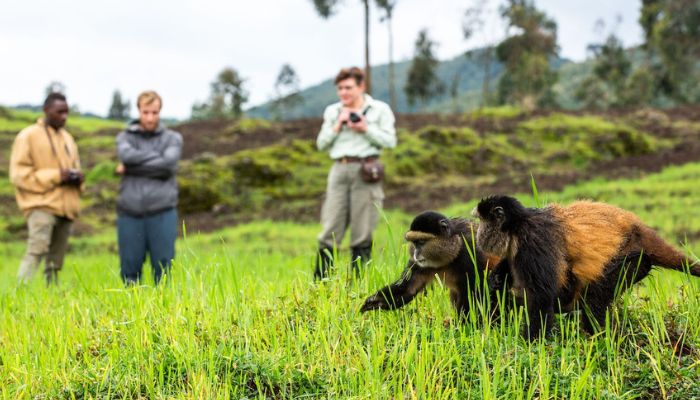
Few wildlife experiences are as thrilling or genuinely magical as golden monkey trekking in Uganda — watching these strikingly colored, endlessly playful primates go about their daily routines in the bamboo forest is something few travelers forget.
Primate lovers already fall for Uganda’s mountain gorillas, but the endangered golden monkey, found only within the Albertine Rift Valley, deserves just as much attention on any Uganda primate safari.
Golden monkey trekking ranks among the best things to do in Uganda — genuine entertainment for primate enthusiasts, real revenue for conservation, and a rare, direct education in one of Africa’s most endangered primate species.
While mountain gorilla trekking tends to get all the attention, coming face to face with golden monkeys in their natural bamboo habitat is an experience no serious primate lover should skip.

Where to Find Golden Monkeys
Very few places on Earth offer the chance to track golden monkeys in the wild. These endangered primates are endemic to the bamboo-dominated lower slopes of the Virunga Volcanoes, a mountain range spanning the borders of Uganda, Rwanda, and the Democratic Republic of Congo.
In Uganda, golden monkey trekking happens exclusively in Mgahinga Gorilla National Park, a compact 34-square-kilometer park in the country’s southwest.
Mgahinga forms part of the wider Virunga Conservation Area, which also includes Rwanda’s Volcanoes National Park and Virunga National Park in the DRC — meaning golden monkey trekking pairs naturally with a broader Rwanda-Uganda primate itinerary for travelers covering more than one country.
Exciting Facts About Golden Monkeys
Golden monkeys are scientifically classified as Cercopithecus kandti, sometimes treated as a subspecies of the blue monkey (Cercopithecus mitis kandti), and belong to the Cercopithecidae family.
They’re herbivorous, feeding on 20–30 different plant species, with bamboo leaves as their clear favorite, supplemented by fruit and the occasional insect for extra protein.
Golden monkeys are listed as Endangered on the IUCN Red List, facing ongoing pressure from poaching, habitat loss, and disease. As members of the “Old World Monkey” group, they’re immediately recognizable by the golden-brown patch running from their long tail up their back, cheeks, and sides — the exact feature that gives them their name.
They inhabit the lower slopes of the Virunga Volcanic Mountains across East and Central Africa, and display clear sexual dimorphism, with females noticeably lighter in color than males.
Gestation lasts just 5 months, notably shorter than most primates, and infants are born with minimal fur and wide-open eyes, nursing for roughly two years before becoming fully independent.
Golden monkeys can live up to 19 years in the wild. As highly social animals, they live in troops of 30 to 100 individuals, foraging together on bamboo branchlets, leaves, and shoots, along with fruit, flowers, shrubs, and the occasional invertebrate.
How Golden Monkey Trekking in Uganda Works
Mgahinga Gorilla National Park remains the only place in Uganda to trek golden monkeys, with two habituated troops currently available for tourism.
This gives primate lovers a genuine once-in-a-lifetime opportunity — spending a full hour photographing and observing their behavior and physical characteristics as they move through the bamboo forest.
Guided golden monkey trekking begins at the Ntebeko Visitor Center around 8:00 AM, following a pre-tracking briefing and registration. The hike itself, through the lower slopes of the Virunga Volcanoes, is noticeably shorter than mountain gorilla trekking — typically 1 to 3 hours — followed by a full hour with the troop for observation and photography.
The minimum age for golden monkey tracking in Uganda is 12 years, and a basic level of fitness is recommended given the terrain.
Golden Monkey Trekking vs. Gorilla Trekking
For travelers deciding how to structure their Uganda primate safari, golden monkey trekking makes an excellent complement to gorilla trekking rather than a substitute for it.
The trek itself is shorter and less physically demanding, the permit is significantly cheaper, and there’s no daily visitor cap the way there is with gorilla permits — making it easy to add on with minimal advance planning.
Many travelers combine both activities into a single Mgahinga-based itinerary, trekking gorillas one day and golden monkeys the next, for a genuinely complete Virunga primate experience.
If you’re deciding between Uganda and Rwanda for your primate trip more broadly, our Rwanda vs. Uganda gorilla trekking comparison covers how golden monkey access factors into that decision too — Rwanda’s Volcanoes National Park also offers golden monkey trekking, often bundled directly with gorilla permits.
Golden Monkey Trekking Permits for Uganda
Golden monkey trekking permits in Uganda cost $60 per person for foreign residents and non-residents, or UGX 40,000 for East African Community resident travelers — a fraction of the cost of a gorilla trekking permit, making it an accessible add-on for almost any Uganda itinerary.
Unlike gorilla trekking, there’s no cap on daily visitor numbers, and permits can often be booked on the day of the trek itself, though booking ahead is still recommended in peak season.
Permits are issued by the Uganda Wildlife Authority and should be purchased through a credible, licensed tour operator. Hail Tours Uganda handles both the permit purchase and the full trekking safari logistics — contact us to get started.
Best Time of Year for Golden Monkey Trekking in Uganda
Golden monkey trekking runs year-round, though each season brings its own trade-offs.
Dry season (June–September and December–February): widely considered the best window, with drier, firmer forest trails that make for easier hiking. Demand for permits rises accordingly, so booking ahead is worth doing during these months.
Wet season (March–May and October–November): trails turn muddier and more slippery, adding real challenge to the bamboo forest hike. On the upside, treks often run shorter since abundant vegetation keeps the monkeys closer to the trailhead, and many lodges offer discounted rates during this quieter period.
Accommodation for Golden Monkey Trekking in Uganda
A comfortable place to stay makes a real difference to the overall experience, and Mgahinga Gorilla National Park offers a solid range of options with views over the forest and Virunga peaks.
Choices include the luxury Mount Gahinga Lodge, Kisoro Travelers Rest Camp, Kisoro Tourist Hotel, Mucha Hotel, Amajambere Iwacu Camp, and Lake Mulehe Safari Lodge, among others. For a broader look at where to stay across Uganda’s parks, see our guide to Uganda’s best safari lodges.
Packing List for Golden Monkey Trekking in Uganda
Golden monkey trekking involves navigating the rugged lower slopes of the Virunga Volcanoes and dense bamboo forest, which can turn genuinely challenging when wet and muddy. Pack accordingly:
- Lightweight rain jacket
- Lightweight long-sleeved shirt
- Sturdy, comfortable hiking boots with solid ankle support
- Cotton socks
- Sunscreen
- Wide-brim safari hat
- Basic first aid kit
- Toiletries (hand and body lotion, toothbrush, hand sanitizer, toothpaste, wet wipes, deodorant, comb or brush, hand towel, and similar essentials)
- Insect repellent
- A sizeable, waterproof backpack
- Breathable safari pants in khaki, brown, green, or dark blue
- Sunglasses
- Gardening gloves
- A reusable water bottle
Golden Monkey Conservation and Why Your Visit Matters
Golden monkeys face real, ongoing threats — habitat loss from agricultural expansion around the Virunga foothills, poaching, and disease transmission all continue to pressure their population.
Trekking tourism directly funds the conservation work protecting them: permit revenue supports ranger patrols, habitat protection, and community programs around Mgahinga that reduce pressure on the park’s boundaries.
Every golden monkey trek booked through a licensed operator is, in a very direct sense, a contribution to keeping this endangered species viable for the long term.
FAQs About Golden Monkey Trekking
How long does golden monkey trekking take in Uganda? The hike itself typically runs 1 to 3 hours, followed by a full hour observing the troop — shorter overall than most mountain gorilla treks.
How much does a golden monkey trekking permit cost? $60 per person for foreign visitors, or UGX 40,000 for East African Community residents — considerably less than a gorilla trekking permit.
Can I combine golden monkey trekking with gorilla trekking in Uganda? Yes — both activities are based in the same Mgahinga Gorilla National Park area, making it easy to trek gorillas one day and golden monkeys the next on a single itinerary.
What is the minimum age for golden monkey trekking? 12 years old, with a reasonable level of basic fitness recommended for the hike.
When is the best time to go golden monkey trekking in Uganda? The dry seasons — June to September and December to February — offer the easiest trail conditions, though trekking is possible and rewarding year-round.
Plan Your Golden Monkey Trekking Safari With Us
Golden monkey trekking in Uganda offers a genuinely rare, affordable, and deeply rewarding primate encounter — one that pairs naturally with gorilla trekking for travelers who want the full Virunga primate experience in one trip.
Hail Tours Uganda handles permit booking, accommodation, and transport for every golden monkey safari we run, with knowledgeable local guides who know Mgahinga’s bamboo forest trails well.
Contact us today to plan your golden monkey trekking safari in Uganda, or explore our Uganda safari activities to see how it fits alongside gorilla trekking, chimpanzee tracking, and classic game drives for a genuinely complete East Africa adventure.
Related Pages
- Mgahinga Gorilla National Park
- Uganda Gorilla Trekking
- Gorilla Trekking Rwanda vs Uganda
- Volcanoes National Park, Rwanda
- 3 Day Gorilla & Golden Monkey Trekking Rwanda
- 2 Days Rwanda Gorilla Safari
- Bwindi Impenetrable National Park
- Uganda National Parks
- Uganda Safari Activities
- Best Time to Visit Uganda
- Best Uganda Safari Lodges
- Uganda Safari Itinerary Price Guide
- About Hail Tours Uganda