
Where Do Sloths Live? Top Guide to Sloth Habitat and Geographic Distribution
Where Do Sloths Live: Sloths live exclusively in the tropical rainforests of Central and South America. They are found in countries including Costa Rica, Panama, Colombia, Brazil, Peru, Venezuela, Ecuador, Bolivia, and parts of Honduras and Nicaragua. These slow-moving mammals spend almost their entire lives high in the dense tree canopies of warm, humid lowland rainforests.
If you’re searching for where do sloths live, sloth habitat, sloth location, or where are sloths found, this comprehensive guide provides everything you need to know.
From detailed geographic distribution to why they are strictly arboreal (tree-dwelling), we explore the unique environment that sustains these fascinating creatures.
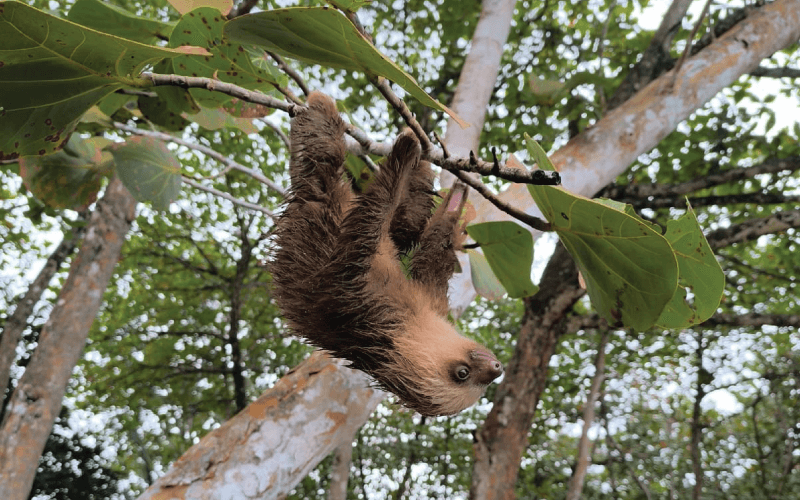
Geographic Distribution of Sloths
Sloths have a Neotropical distribution limited to Central and South America. They do not occur naturally anywhere else in the world, including Africa, Asia, or North America outside of ancient fossil records.
In Central America, sloths are commonly spotted in Costa Rica and Panama, where lush rainforests provide ideal conditions. Countries like Honduras and Nicaragua also host populations, particularly Hoffmann’s two-toed sloth.
In South America, the distribution is much broader. Brazil is home to the highest number of sloth species and individuals, followed by Venezuela, Colombia, Peru, Ecuador, Bolivia, and the Guianas (Guyana, Suriname, French Guiana).
The Amazon rainforest serves as the core stronghold for most populations, while some species also inhabit the Atlantic Forest along Brazil’s coast.
The Amazon Basin represents the largest continuous habitat, offering vast interconnected canopies. Other key regions include the rainforests of the Andean foothills and coastal lowland forests.
Sloth species ranges vary: some are widespread, while others, like the pygmy three-toed sloth, are restricted to tiny areas such as Escudo de Veraguas Island off Panama.
Sloth Habitat: Life in the Tropical Rainforest Canopy
Sloths are strictly arboreal animals, meaning they live almost entirely in trees. Their preferred sloth habitat consists of dense, humid tropical rainforests with tall, mature trees that form a continuous canopy layer.
These environments feature:
- Warm temperatures year-round (typically 20–30°C / 68–86°F)
- High humidity and frequent rainfall
- Abundant leafy vegetation for food
- Layered forest structure providing safety and movement corridors
High in the canopy (often 20–40 meters above ground), sloths remain hidden from many ground predators while accessing their primary food source — leaves. The dense foliage also supports the algae that grows on their fur, providing natural camouflage.
Types of Sloths and Their Specific Locations
There are six living species of sloths divided into two main groups: two-toed and three-toed.
Two-toed sloths (genus Choloepus) tend to have a wider distribution. Linnaeus’s two-toed sloth inhabits northern South America, including Venezuela, the Guianas, Colombia, Ecuador, Peru, and parts of Brazil north of the Amazon. Hoffmann’s two-toed sloth ranges from Central America (Costa Rica, Panama, Honduras) into northern South America, with populations separated by the Andes in some areas.
Three-toed sloths (genus Bradypus) often have more specialized habitats. The brown-throated three-toed sloth is the most widespread, found across Central and South America.
The pale-throated three-toed sloth lives in northern South America, while the maned three-toed sloth is restricted to Brazil’s Atlantic Forest. The critically endangered pygmy three-toed sloth exists only on one small island in Panama.
This variation in sloth location reflects subtle differences in diet, climate tolerance, and historical evolution.
Why Sloths Live in Trees: Behavior and Adaptations
Sloths evolved to live high in the trees for several critical reasons. The canopy offers excellent protection from ground-based predators such as jaguars and large snakes.
Being arboreal also keeps them close to their food — tender leaves, buds, and occasional fruits — without expending much energy traveling.
Their slow metabolism and low-energy lifestyle thrive in this stable, humid environment. Hanging upside down with specialized curved claws allows them to rest and feed efficiently while conserving strength.
Trees provide the perfect microclimate: shelter from direct sun, consistent moisture, and a network of branches for limited movement.
Climate Requirements for Sloth Survival
Sloths depend on consistently warm, humid conditions typical of equatorial rainforests. They have poor thermoregulation and rely on the stable forest temperatures to maintain their low body heat. High humidity supports the symbiotic algae and insects in their fur, while frequent rain ensures lush leaf growth.
Any significant change in rainfall patterns or temperature due to climate change can disrupt their delicate balance, making healthy rainforest ecosystems essential for their survival.
Regional Breakdown of Sloth Habitats
- Amazon Basin — The largest and most important region, spanning multiple countries and supporting the greatest diversity and numbers of sloths.
- Central American Rainforests — Smaller but highly visited areas in Costa Rica and Panama, where sloths are popular with eco-tourists.
- Atlantic Forest (Brazil) — A biodiversity hotspot now heavily fragmented, home to the vulnerable maned sloth.
- Andean Foothills and Coastal Lowlands — Transitional zones supporting edge populations.
Visualizing these areas on a map would show a band stretching from southern Mexico/Central America down through the northern half of South America, concentrated around the equator.
Can Sloths Live Outside Rainforests?
In the wild, sloths rarely survive outside intact tropical rainforests. They are highly specialized and struggle in open areas, secondary forests, or urban environments due to lack of food, shelter, and safe movement corridors.
In captivity, sloths can thrive in well-designed zoo enclosures or wildlife sanctuaries that mimic rainforest conditions with appropriate temperature, humidity, climbing structures, and diet. However, they are never found naturally outside the Neotropics.
Threats to Sloth Habitat
The biggest danger to sloths is habitat loss through deforestation for agriculture, logging, cattle ranching, and urban expansion. Habitat fragmentation isolates populations, making it harder for sloths to find mates or sufficient food.
Climate change, illegal pet trade, and road construction also pose serious risks. Some species, like the maned three-toed sloth, are classified as Vulnerable by the IUCN, while the pygmy three-toed sloth is Critically Endangered due to its tiny range. Conservation efforts focus on protecting large, connected rainforest areas and restoring degraded habitats.
Quick Sloth Facts Table
|
Feature |
Sloths |
|
Habitat |
Tropical rainforests |
|
Region |
Central & South America |
|
Lifestyle |
Arboreal (tree-dwelling) |
|
Climate |
Warm, humid |
|
Primary Threat |
Deforestation and habitat fragmentation |
FAQ About Where Sloths Live
Where do sloths live in the wild?
Exclusively in the tropical rainforests of Central and South America, high in the tree canopies.
Do sloths live in Africa?
No, sloths are not found in Africa or any other continent outside the Americas in the wild. Africa has its own unique slow-moving tree-dwellers, such as the potto, but true sloths never naturally occurred there. Many travelers fascinated by slow, arboreal wildlife enjoy similar magical forest experiences by visiting Africa’s primate-rich rainforests instead.
What countries have the most sloths?
Brazil has the largest populations and highest diversity, followed by Colombia, Peru, Venezuela, Costa Rica, and Panama.
Can sloths survive in zoos outside their native range?
Yes, with proper care replicating warm, humid conditions and providing suitable climbing structures and diet.
Why are sloths only found in rainforests?
Their entire physiology — slow metabolism, leaf-based diet, and specialized claws — is adapted to the stable, resource-rich canopy of tropical forests.
Conclusion
Sloths are perfectly adapted to their unique sloth habitat in the tropical rainforests of Central and South America. From the dense canopies of Costa Rica and Panama to the vast Amazon Basin in Brazil, Peru, and Colombia, these remarkable animals thrive where few others can — by moving slowly and blending into the greenery.
While you won’t find sloths in Africa, the continent offers its own unforgettable slow-paced wildlife encounters in lush forests. If you’re passionate about primates, tree-dwelling animals, and immersive nature experiences, consider exploring Uganda’s incredible rainforests. Hails Tours Uganda, a trusted local Uganda tour operator, specializes in Uganda safari packages that bring you close to mountain gorillas, chimpanzees, and other fascinating primates in places like Bwindi Impenetrable National Park and Kibale Forest.
Their customized gorilla trekking Uganda tours and primate safaris deliver the same sense of wonder and calm connection with nature that sloth enthusiasts crave.
With experienced guides, comfortable transport, and focus on responsible tourism, Hails Tours Uganda makes it easy and memorable to witness Africa’s majestic wildlife up close.
Whether planning a family adventure, couples romantic safari, or dedicated primate experience, contact Hails Tours Uganda today for tailored Uganda wildlife safari booking.
Discover why so many travelers choose them among Uganda safari tour operators for authentic, high-quality experiences in East Africa’s best forests.
Protecting habitats — whether in the Americas for sloths or in Uganda for gorillas — ensures these slow wonders continue to enchant future generations. Start planning your next wildlife journey with Hails Tours Uganda and create memories that last a lifetime.