
What Do Sloths Eat? A Complete Guide to the Sloth Diet
What Do Sloths Eat: Sloths mainly eat leaves, buds, and tender shoots from rainforest trees. Some species also eat fruits, flowers, and occasionally insects. Their diet is almost entirely plant-based, and it is perfectly matched to one of the slowest, most energy-efficient lifestyles of any mammal on earth.
If you have ever wondered what do sloths eat in the wild — and why they seem so unbothered by everything — the answer starts with leaves and ends with a digestive system so remarkably slow it can take an entire month to process a single meal.
This guide covers everything about the sloth diet: what they eat, how they eat it, how they digest it, and why their food choices shape almost every aspect of their extraordinary lives.
The Main Diet of Sloths
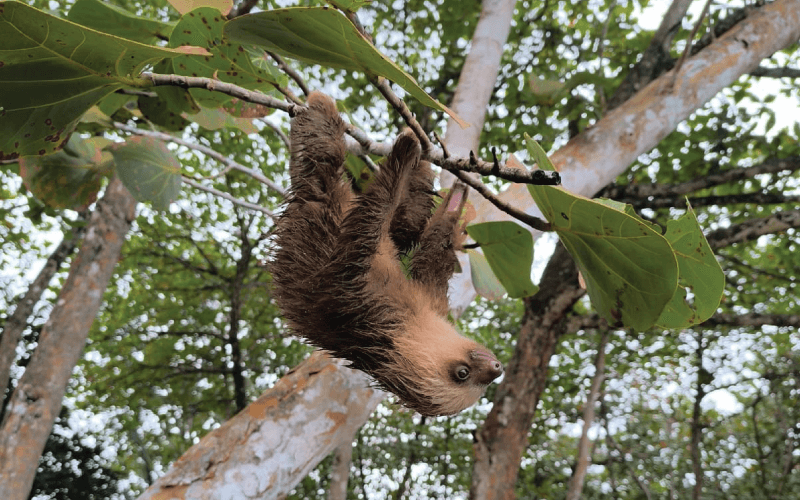
The core of the sloth food supply is leaves — specifically, the leaves of rainforest trees found in the tropical forests of Central and South America. Leaves make up the vast majority of a sloth’s diet, and not just any leaves. Sloths are remarkably selective feeders, often favouring particular tree species above all others.
The Cecropia tree is perhaps the most well-known food source for sloths, particularly three-toed sloths. Cecropia trees are fast-growing, abundant in tropical forests, and produce leaves that sloths seem to find especially palatable. Beyond Cecropia, sloths feed from a wide variety of canopy trees, rotating between dozens of species throughout their home range over the course of weeks and months.
In addition to leaves, sloths also eat:
- Buds and young shoots — softer and more nutritious than mature leaves
- Flowers — particularly favoured by two-toed sloths
- Fruits — eaten opportunistically when available
- Plant sap and bark — occasionally consumed in small amounts
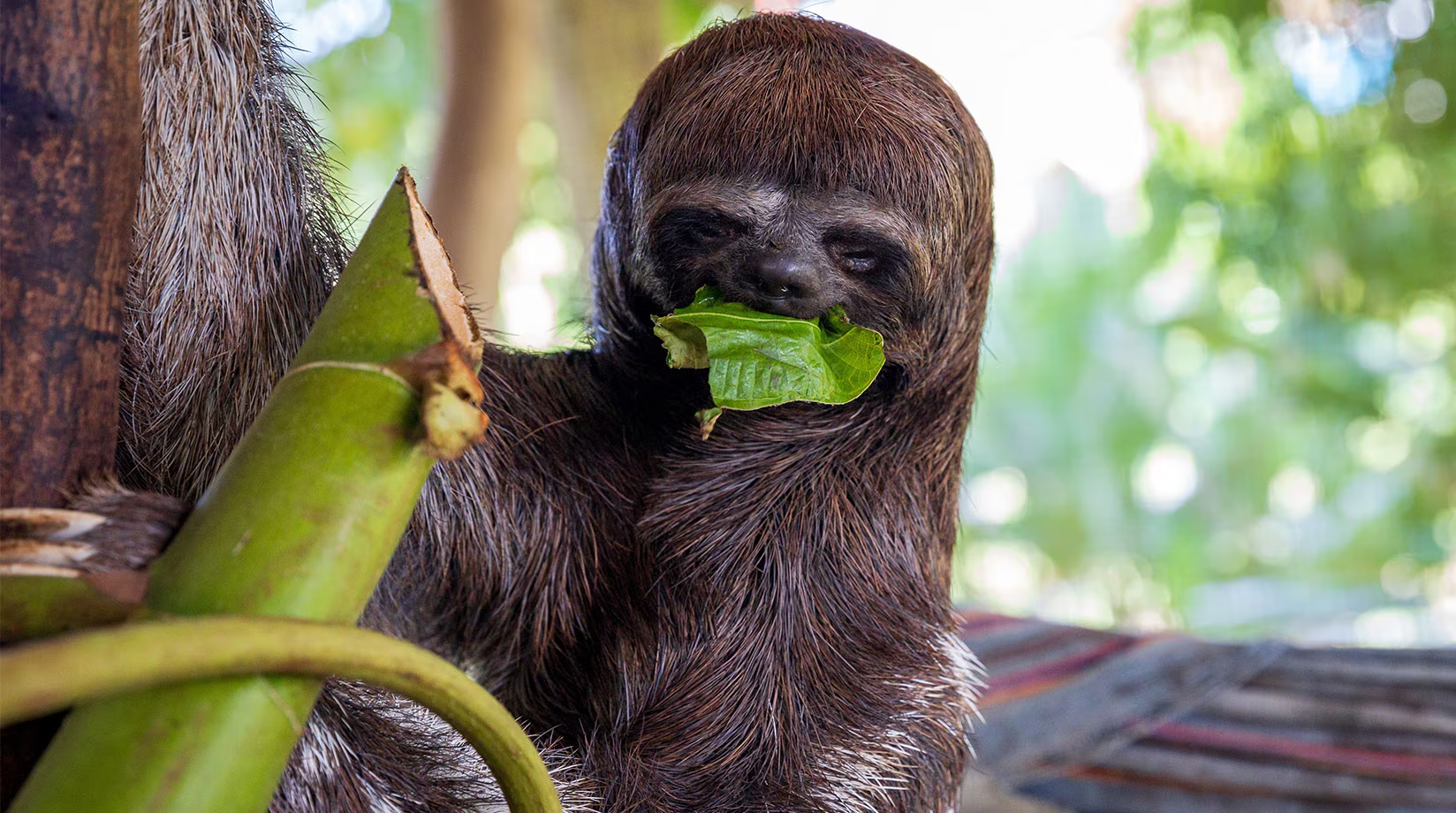
The sloth feeding habits that emerge from this diet are defined by two words: slow and selective. Sloths do not eat large quantities of food. They eat small amounts very carefully, choosing individual leaves with precision before slowly pulling them into their mouths with their lips — they have no upper front teeth to bite with.
Differences in Diet Between Sloth Species
Not all sloths eat exactly the same things. There are six species of sloths divided into two main groups — three-toed sloths and two-toed sloths — and their diets differ in meaningful ways.
Three-Toed Sloths
Three-toed sloths are the more strictly herbivorous of the two groups. Their sloth diet consists almost entirely of leaves, with a strong preference for the leaves of specific tree species. They are highly selective — studies have shown that three-toed sloths may eat leaves from as many as 40 different tree species, but at any given time show clear preferences for a small handful. They rarely eat fruit and almost never eat anything of animal origin.
Three-toed sloths also have a notably specialised digestive system even by sloth standards, and their reliance on specific tree species makes them more vulnerable to habitat loss than their two-toed relatives.
Two-Toed Sloths
Two-toed sloths have a broader, more varied diet. While leaves still form a significant part of what they eat, two-toed sloths are considerably more opportunistic. They eat fruits more readily, consume more flowers, and have been documented eating bird eggs, small lizards, and insects on occasion — making them technically omnivorous in some contexts, though plant matter still dominates their intake.
Two-toed sloths are also more nocturnal than three-toed sloths, and much of their feeding activity happens after dark when predation risk is lower and their movements are harder to track through the canopy.
Why Sloths Eat Leaves
Understanding what do sloths eat requires understanding why leaves — one of the lowest-energy food sources available in a tropical forest — make any sense as a primary diet at all.
The answer lies in the sloth’s extraordinary metabolism. Sloths have the lowest metabolic rate of any non-hibernating mammal. Their internal temperature fluctuates with the environment rather than being maintained at a constant level like most warm-blooded animals, meaning they expend far less energy simply existing. Their muscles contain roughly half the mass of other mammals of equivalent size, further reducing energy demands.
Leaves, while nutritionally poor, are available in almost unlimited quantities in the rainforest canopy. A sloth never has to travel far to find food, never has to compete aggressively for it, and never has to spend significant energy hunting or foraging. The energy cost of eating leaves is low enough to match the sloth’s minimal energy budget — and that is the point.
This dietary strategy is one of the most successful evolutionary trade-offs in the animal kingdom. By accepting a low-energy food source in exchange for a low-energy lifestyle, sloths have thrived in tropical forests for millions of years.
How Sloths Digest Food
The sloth diet does not just move slowly into the mouth — it moves slowly through the entire body. Sloth digestion is one of the most remarkable processes in mammalian biology.
Sloths have a large, multi-chambered stomach similar in concept to that of a cow. Inside this stomach, specialised bacteria and microorganisms break down the tough cellulose in leaves through a process of fermentation. This fermentation takes a very long time — a single meal can remain in a sloth’s stomach for anywhere from several days to several weeks before it is fully processed.
In fact, the stomach contents of a sloth can account for up to one-third of its total body weight at any given time. This is why sloths appear so round and full — their digestive system is essentially always working on a backlog of slowly fermenting leaves.
Because digestion generates so little usable energy from such fibrous material, sloths have adapted to extract every possible calorie from what they consume. Gut passage is slow, absorption is thorough, and the entire process is a masterclass in biological efficiency. Sloths defecate only about once a week — one of the few occasions they descend to the forest floor — and each bowel movement can represent up to a third of their body weight released at once.
Where Sloths Find Food
Sloths source almost all of their sloth food from the high canopy of tropical rainforests without ever coming down to the ground. They are supremely adapted for life in the treetops — their curved claws hook around branches effortlessly, their inverted posture (hanging upside-down) is actually their resting default, and their camouflaged fur (which often hosts green algae) makes them nearly invisible among leaves.
A sloth’s home range is typically small — often just a few trees that they rotate between over the course of weeks. This minimal movement is not laziness; it is a deeply effective energy conservation strategy. By knowing exactly which trees produce the best leaves in which season, a sloth can meet all of its nutritional needs within a very small territory.
Most three-toed sloths feed during the day, positioning themselves in sun-warmed branches to assist their body temperature regulation. Two-toed sloths, as noted, tend to feed at night. Both species rely heavily on smell and touch to identify suitable leaves, as their vision is limited.
Sloth Feeding Behaviour
Watching a sloth eat is an exercise in patience. Their sloth feeding habits are defined by extraordinary slowness and deliberate selectivity.
A sloth will typically reach for a leaf, examine it carefully, and then slowly draw it into the mouth using its lips. Chewing is gradual and methodical — their peg-like teeth grind leaves over long periods before the material is swallowed. Between bites, sloths often pause for extended periods, conserving energy even during the act of eating itself.
Sloths are also selective about which individual leaves they eat from a given tree. Young, tender leaves are preferred over old, tough ones because they contain more protein and fewer defensive chemicals.
Some mature leaves contain toxins — sloths appear to have some tolerance for certain plant toxins, but they still show clear preferences for less chemically defended plant material.
What Do Sloths Eat in the Wild vs Captivity
In the Wild
A wild sloth’s diet is dominated by leaves from canopy trees, supplemented with buds, shoots, flowers, and occasional fruit. The specific species of trees vary by geographic region and season, but the broad pattern remains consistent: low-energy plant material eaten in small amounts throughout the day or night.
In Captivity
Caring for sloths in captivity is notoriously difficult, largely because replicating their wild diet is complex. Captive sloths are typically fed a combination of fresh leaves (where available), vegetables such as sweet potatoes, carrots, and leafy greens, ripe fruits, and nutritional supplements.
Zoological facilities with successful sloth programs invest significant resources in sourcing appropriate leaf species and consulting with nutritionists to ensure their animals receive balanced diets.
Sloths in captivity that are fed inappropriate diets — too much fruit, insufficient fibre, wrong nutrient ratios — frequently develop health problems including digestive disorders and obesity. This reflects how tightly the sloth’s biology is calibrated to its natural leaf-based diet.
Challenges With the Sloth Diet
The sloth’s dietary strategy, while brilliantly adapted, comes with real vulnerabilities:
Low Nutritional Value — Leaves provide minimal protein, fat, and calories. Sloths manage this through metabolic adaptation, but there is very little margin for error. A sick sloth or one under significant stress may not be able to extract enough energy from its diet to survive.
Dependence on Specific Tree Species — Three-toed sloths in particular show strong preferences for specific tree species. Deforestation that removes preferred food trees can effectively make an area uninhabitable for sloths even if some forest cover remains.
Habitat Loss — As tropical forests are cleared for agriculture and development, sloths lose both their home and their food supply simultaneously. Unlike more adaptable animals, sloths cannot easily switch to new food sources or travel long distances to find new territory.
Quick Sloth Diet Facts
| Category | Detail |
|---|---|
| Main food | Leaves (especially Cecropia trees) |
| Other foods | Fruits, flowers, buds, shoots |
| Occasional foods (two-toed) | Insects, eggs, small lizards |
| Digestion time | Several days to several weeks |
| Feeding style | Slow, highly selective |
| Defecation frequency | Approximately once per week |
| Stomach capacity | Up to one-third of body weight |
FAQs – What Do Sloths Eat
Do sloths eat meat? Three-toed sloths are entirely herbivorous and do not eat meat. Two-toed sloths occasionally eat insects, bird eggs, and very small animals, making them technically omnivorous — but plant matter, particularly leaves, dominates their diet in all circumstances.
How often do sloths eat? Sloths eat small amounts throughout their active hours — either during the day (three-toed sloths) or at night (two-toed sloths). Because their digestion is so slow and their energy needs so minimal, they do not need to eat large meals or eat frequently by mammalian standards.
What is a sloth’s favourite food? Three-toed sloths show a strong preference for the leaves of Cecropia trees. Two-toed sloths tend to enjoy ripe fruits alongside their leaf intake.
Both species show individual preferences for particular trees within their home range, returning to favoured feeding spots repeatedly.
Why do sloths eat so slowly? Sloths eat slowly because their entire physiology is built around minimising energy expenditure. Their muscles are weaker than most mammals of equivalent size, their nerve conduction is slower, and their metabolism runs at a fraction of the pace of other animals. Eating slowly is not inefficiency — it is a precise match to their energy budget.
Conclusion: The Sloth Diet and Why It Matters
The sloth diet is one of nature’s most elegant examples of evolutionary adaptation. By committing to leaves — abundant, accessible, and requiring zero pursuit — sloths have unlocked a lifestyle of extraordinary energy efficiency that has sustained them for millions of years.
Their slow metabolism, multi-chambered stomach, and selective feeding behaviour are all interlocking solutions to the same challenge: how to thrive on the least possible energy.
Understanding what do sloths eat also highlights how intimately their survival is tied to the health of tropical rainforest ecosystems.
Sloths cannot exist without the canopy trees they eat from, and those forests cannot afford to lose the sloths that inhabit them — sloths contribute to seed dispersal and forest nutrient cycling in ways scientists are still uncovering.
Learning about sloth feeding habits is a window into the wider story of rainforest life and why protecting these ecosystems matters far beyond the animals we can see.
The more we understand animals like the sloth, the better equipped we are to make the case for preserving the wild places they call home.